| Canterbury Scene | Crossover Prog | Eclectic Prog | Extreme Prog Metal | Folk Rock | Heavy Prog | Jazz-Rock Fusion | Krautrock | Neo Prog | NON PROG | Northern Prog | Post Metal | Post Rock | Prog Related | Progressive Electronic | Progressive Metal | Psychedelic Rock | Rock Progressivo Italiano | Space Rock | Symphonic Rock | Zeuhl |
Progressive Rock World

662 Reviews - 379 Artists - 93 Detailed biographical profiles - 26 Prog Meteors - 22 Progressive Rock Subgenres
The elegant and refined Progressive Rock of Camel and the "singing" guitar of Andrew Latimer
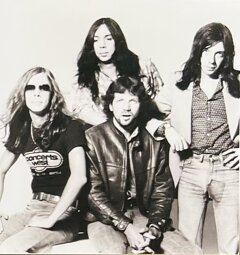
Camel is a British band, founded in 1971 by Andrew Latimer, a progressive rock institution. The classic lineup included Andrew Latimer (guitar, vocals), Peter Bardens (keyboards), Andy Ward (drums), and Doug Ferguson (bass).
In 1973, their excellent self-titled debut album, Camel, and in 1974, Mirage, established them with epic songs like the magnificent "Lady Fantasy." In 1975, they achieved critical and commercial success with The Snow Goose, an entirely instrumental album inspired by Paul Gallico's short story. In 1976, they consolidated their ethereal, jazz-rock style with Moonmadness.
In 1981, they released Nude, a concept album based on the story of a Japanese soldier, and in 1984, Stationary Traveller, which explored themes related to the division of Berlin. (During this period, Latimer remained the only original member after the departure of Bardens and Ward.)
The band has undergone numerous lineup changes over the years, with Latimer remaining a constant presence.
Camel is a seminal progressive rock band and has inspired numerous subsequent bands.
Their sound is among the most elegant and refined in the progressive rock scene, with a less aggressive and more atmospheric approach than contemporary bands. The band's trademark is Andrew Latimer's guitar style, with a blues-inspired technique and a wealth of melodic, fluid, and deeply emotional solos featuring extensive sustain and bending. Especially during the period with Peter Bardens, the sound was dominated by a dense interweaving of keyboards (Hammond, Minimoog, Mellotron) and guitar.
The compositions ranged from purely symphonic moments to passages closer to jazz-rock and fusion. Unlike Jethro Tull, where the flute was percussive and rough, in Camel (played by Latimer) it was the instrument used to create pastoral, dreamy, and melancholic atmospheres, recalling European classical and folk music. Their concept albums were beautiful, true musical narratives, often completely instrumental, such as The Snow Goose (1975), an entirely instrumental masterpiece. The songs alternated complex odd time signatures with open, relaxed melodic sections.
Camel influenced not only 1970s prog but also the genres that grew out of it. They are considered the founders of the neo-prog movement that emerged in the 1980s, with bands like Marillion openly declaring it. Singer Fish has confirmed that Camel's impact was decisive for the band's original sound. Pendragon and IQ are also bands that inherited Latimer's melodic approach and dreamy atmospheres. Their influence is still present today on contemporary prog artists, with Steven Wilson citing Camel among his influences and Opeth's Mikael Åkerfeldt often acknowledging his stylistic debt to Andrew Latimer's guitar playing.
Andrew Latimer has been a true role model for many guitarists; his technique is a benchmark for those seeking an "emotional" sound. Andrew Latimer was and is the soul of Camel, the only founding member who has always led the band. Composer, guitarist, flutist, and singer, he is one of the most influential musicians in progressive rock.
His guitar style is synonymous with elegance and sensitivity, a "vocal" approach to the instrument, in which the guitar is not used to display technical virtuosity as an end in itself, but to tell a story with fluid and melodic phrasing, making the notes "weep" or "sing." Despite Camel's complex structures, Latimer's solo work remains profoundly blues. He uses pentatonic scales and vibrato techniques typical of the blues, but he inserts them into symphonic and modal harmonic contexts, creating a unique hybrid that brings human warmth to progressive rock.
His instruments are the Gibson Les Paul, often a Goldtop 1956, responsible for his dark, dense, and harmonic-rich sound, and the Fender Stratocaster, used for the cleanest and most crystalline sounds, especially in the more rhythmic or delicate sections. He makes masterful use of delay and reverb to give spatial depth to his solos, as well as the volume pedal to create a "violin" effect. In Camel's compositions, Latimer's guitar is almost never solely a solo instrument, but is in constant dialogue with the keyboards (historically those of Peter Bardens). This interweaving creates polyphonic textures where the guitar often takes on the role of a horn section or orchestral soloist. Even today, his style is studied for precision of touch, and despite the passing of the years, his ability to generate emotion through control of dynamics and timbre remains intact and inimitable.
His life has been marked by significant health challenges that have often interrupted his activity; in 2007 he underwent a successful bone marrow transplant to fight polycythemia vera, a rare blood disease, and in 2023 a serious back problem required emergency surgery, which forced the band to cancel their 50th anniversary tour.
The Discography and the Reviews
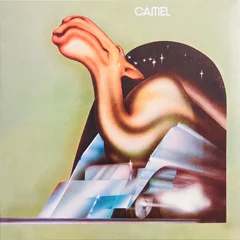
Camel - 1973 - EXCELLENT
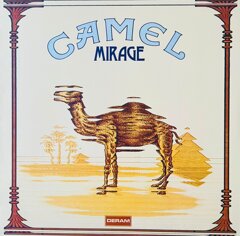
Mirage - 1974 - ESSENTIAL
Moonmadness - 1976 - Coming Soon
Rain Dances - 1977 - Coming Soon
Breathless - 1978 - Coming Soon
I Can See Your House From Here - 1979 - Coming Soon
Nude - 1981 - Coming Soon
The Single Factor - 1982 - Coming Soon
Stationary Traveller - 1984 - Coming Soon
Dust And Dreams - 1991 - Coming Soon
Harbour Of Tears - 1996 - Coming Soon
Rajaz - 1999 - Coming Soon
A Nod and a Wink - 2002 - Coming Soon