.jpeg "whatsapp-image-2025-08-25-at-12.30.38-(1).jpeg")
Tommy, The Who's indispensable 1969 masterpiece, is one of the band's two rock operas, along with Quadrophenia. The album was later adapted into the film Tommy, directed by Ken Russell.
Musically, it's a complex set of pop-rock arrangements, based primarily on Townshend's acoustic guitar and constructed with overdubs performed by all four band members using various instruments, including bass, electric and acoustic guitar, piano, organ, drums, gong, timpani, trumpet, French horn, vocal harmonies, and frequent doubling of the lead vocal.
Despite being a concept album, each song is beautiful even when taken individually and without following the logical thread of the concept.
The sound is predominantly rock, but with pop accents and moments of "almost" prog, with great care and excellence in the compositions and performance.
Tommy tells the story of a boy born at the end of the First World War (in the film version, however, the plot takes place at the end of the Second World War), who becomes deaf, blind, and mute, with tragic consequences for his family.
A work that owes its genesis to Pete Townshend, inspired by the teachings of the guru Meher Baba and by autobiographical elements connected to his childhood.
A year before the album's release, Townshend explained the genesis of many of the ideas that ultimately found their way into the work in an interview.
"The blind, deaf, and mute boy is played by The Who, the musical entity. He's represented musically, represented by a theme we play, which opens and closes the work itself, and then there's a specific song that describes his being deaf and dumb and blind. But the main thing is that, being impaired in that way, the boy perceives things in the form of vibrations that he transforms into music. That's what we really want to create: to create that kind of feeling where you listen to the music and picture the boy in your mind, and everything he represents, because we're creating it as we play."
It's impossible to do a track-by-track review of such a long and complex album; it needs to be listened to fully appreciate its beauty, especially considering that the "filler" tracks are an integral part of the narrative. I'll limit myself to mentioning the ones that impressed me the most.
Overture, a beautiful piece where John Entwistle excels on brass, and there's great work by Keith Moon, John Entwistle, and Pete Townshend. Townshend's acoustic guitar is beautiful.
1921 is one of my favorite songs, with beautiful arrangements and, once again, the guitars.
Amazing Journey is a psychedelic piece with Entwistle's excellent bass.
Sparks is a stripped-down version of "Underture," both beautiful.
Eyesight to the Blind, composed by Sonny Boy Williamson, is beautifully played on banjo by Townshend.
"Cousin Kevin" and "Fiddle About" have the darkest lyrics on the album and are musically beautiful.
"Christmas" features beautiful vocals.
"Acid Queen," sung by Townshend, is one of my favorite songs.
"Underture," a beautiful instrumental with a great Keith Moon on drums and percussion.
"Pinball Wizard," "Sensation," "Sally Simpson," "I'm Free," and "We Are Not Gonna Take It" are also beautiful.
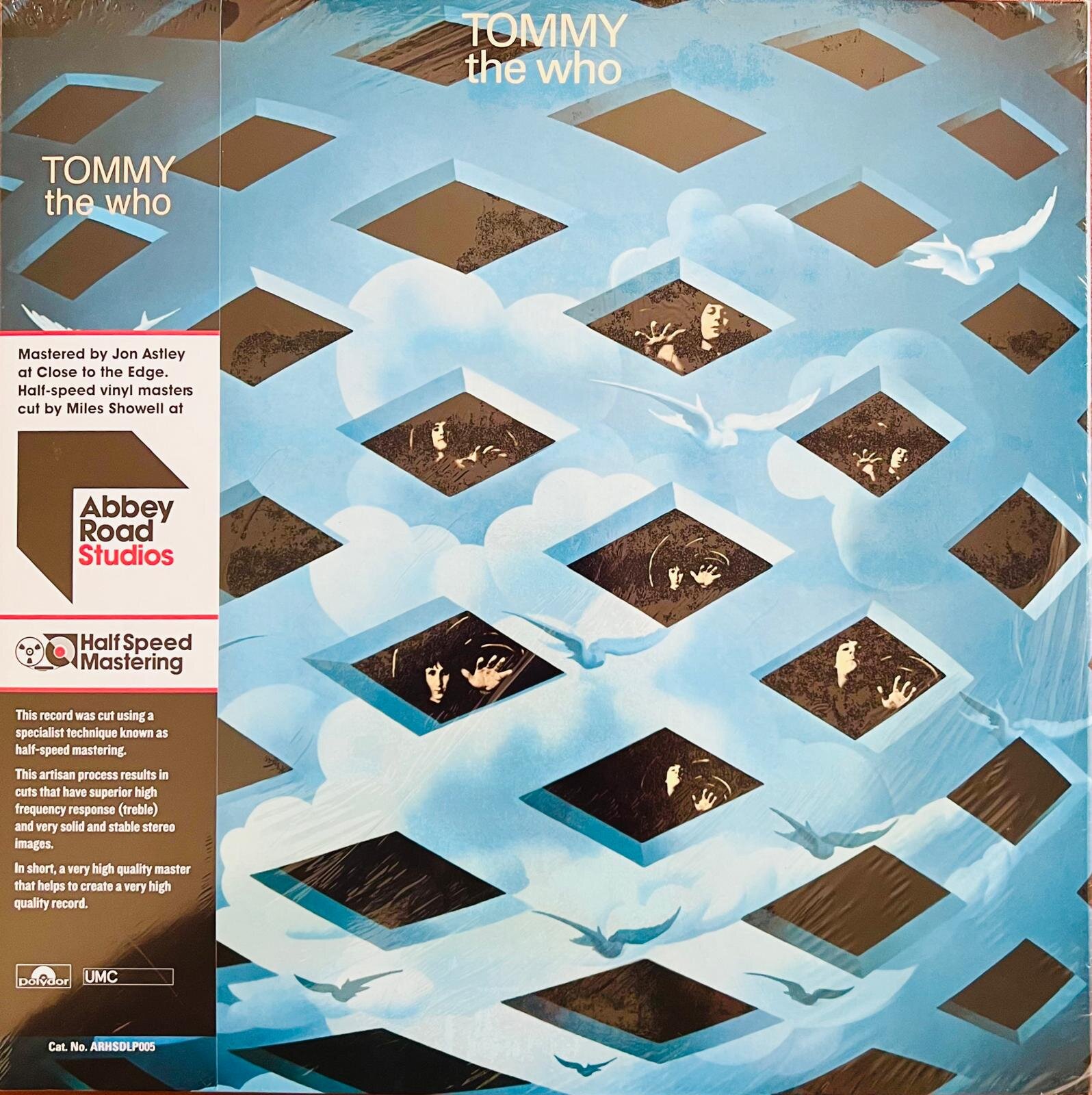
The cover, by Mike McInnerney, is beautiful. It features a blue sphere, clouds, and doves surrounding the square openings, resembling a cage containing the black and white, high-contrast portraits of the band members. The effect of the sphere is clearly visible when the cover is fully opened (pictured). On the back, flocks of doves fill the black background, pierced by a punch.
The work expresses the sense of oppression and the resulting potential liberation of a teenager like Tommy, isolated both sensorially and socially from the world around him, which presents him only with hypocrisy, violence, and injustice.
One of the most important works of the twentieth century, the success of Tommy was fundamental to everything related to the world of rock. With this album, The Who positioned themselves as one of the most innovative bands, thanks above all to the genius of Pete Townshend, and subsequent works such as Who's Next and Quadrophenia confirm this.
Indispensable.
The Songs
1. Overture (5:20)
2. It's A Boy (0:38)
3. 1921 (2:48)
4. Amazing Journey (5:04)
5. Sparks (2:05)
6. Eyesight To The Blind (The Hawker) (2:14)
7.Christmas (4:32)
8. Cousin Kevin (4:06)
9. The Acid Queen (3:34)
10. Underture (10:04)
11. Do You Think It's Alright? (0:24)
12. Fiddle About (1:31)
13. Pinball Wizard (3:01)
14. There's A Doctor (0:23)
15. Go To The Mirror! (3:47)
16. Tommy Can You Hear Me? (1:35)
17. Smash The Mirror (1:34)
18. Sensation (2:28)
19. Miracle Cure (0:12)
20. Sally Simpson (4:10)
21. I'm Free (2:39)
22. Welcome (4:32)
23. Tommy's Holiday Camp (0:57)
24. We're Not Gonna Take It (3:28)
Running Time 1:11:19
The Lineup
- Roger Daltrey - lead vocals and backing vocals (3), harmonica (?)
- Pete Townshend - guitars, piano, organ, lead vocals/co-lead vocals (1-3, 8, 9, 11, 13-15, 18, 19, 23, 24), banjo (23)
- John Entwistle - bass, French horn, trumpet, flugelhorn, lead vocals/co-lead vocals (8, 12-15, 19, 24)
- Keith Moon - drums, timpani, gong, tambourine, vocals
With:
- Paul Townshend (Pete's brother) - backing vocals
- Simon Townshend (Pete's brother) - backing vocals
.jpeg "whatsapp-image-2025-08-25-at-12.30.38-(2).jpeg")
.jpeg "whatsapp-image-2025-08-25-at-12.30.38-(3).jpeg")
.jpeg "whatsapp-image-2025-08-25-at-12.30.38-(4).jpeg")
.jpeg "whatsapp-image-2025-08-25-at-12.30.38-(5).jpeg")
.jpeg "whatsapp-image-2025-08-25-at-12.30.38-(6).jpeg")
.jpeg "whatsapp-image-2025-08-25-at-12.30.38-(7).jpeg")
.jpeg "whatsapp-image-2025-08-25-at-12.30.38-(8).jpeg")
.jpeg "whatsapp-image-2025-08-25-at-12.30.38-(9).jpeg")
.jpeg "whatsapp-image-2025-08-25-at-12.30.38-(10).jpeg")
.jpeg "whatsapp-image-2025-08-25-at-12.30.38-(11).jpeg")
.jpeg "whatsapp-image-2025-08-25-at-12.30.38-(12).jpeg")
.jpeg "whatsapp-image-2025-08-25-at-12.30.38-(13).jpeg")
.jpeg "whatsapp-image-2025-08-25-at-12.30.38-(14).jpeg")