
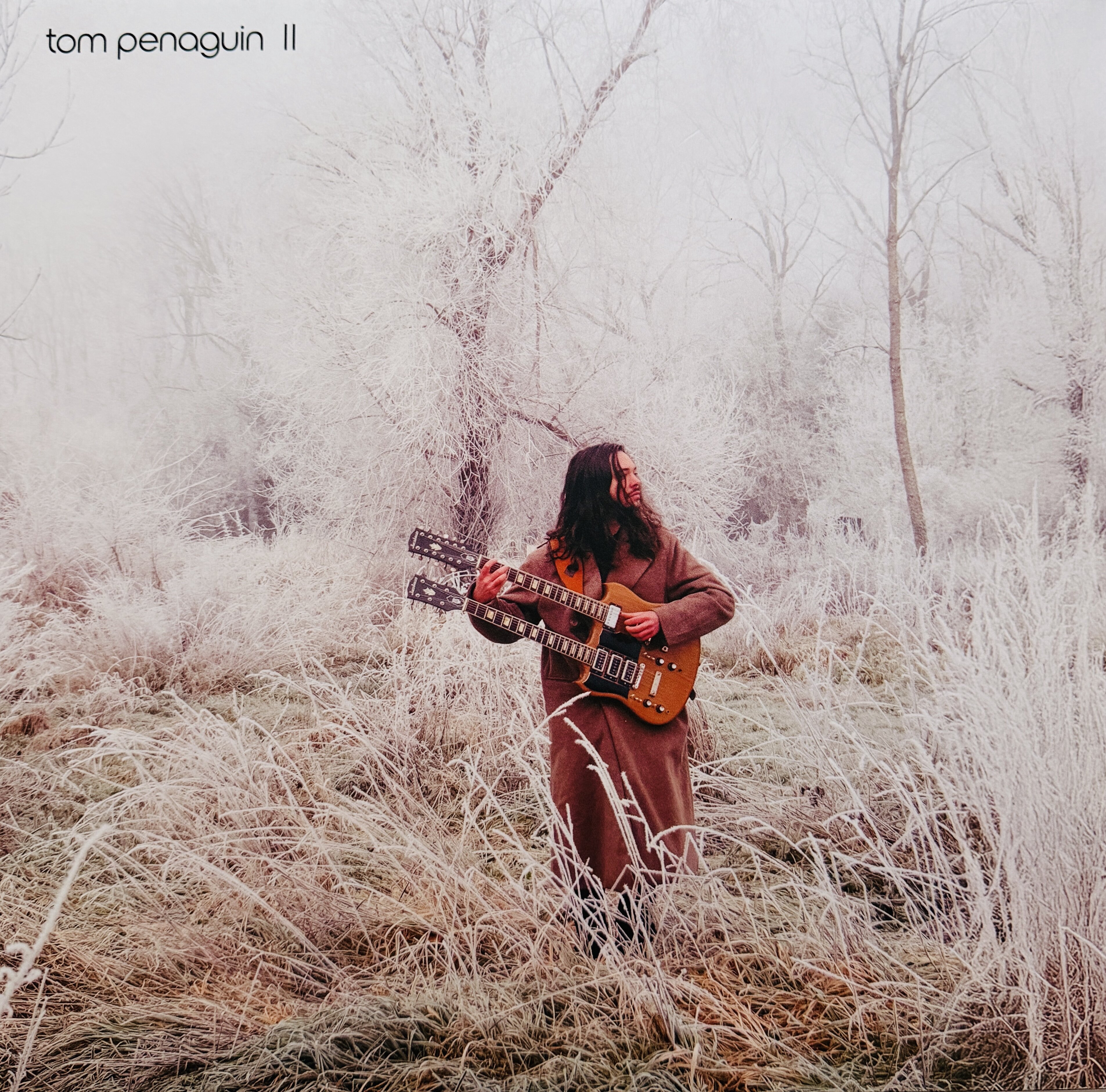
Tom Penaguin II by Tom Penaguin, 2026 album.
It is his second studio album released through the label áMARXE Records, which in recent years has given us very important releases for the continuity and evolution of prog.
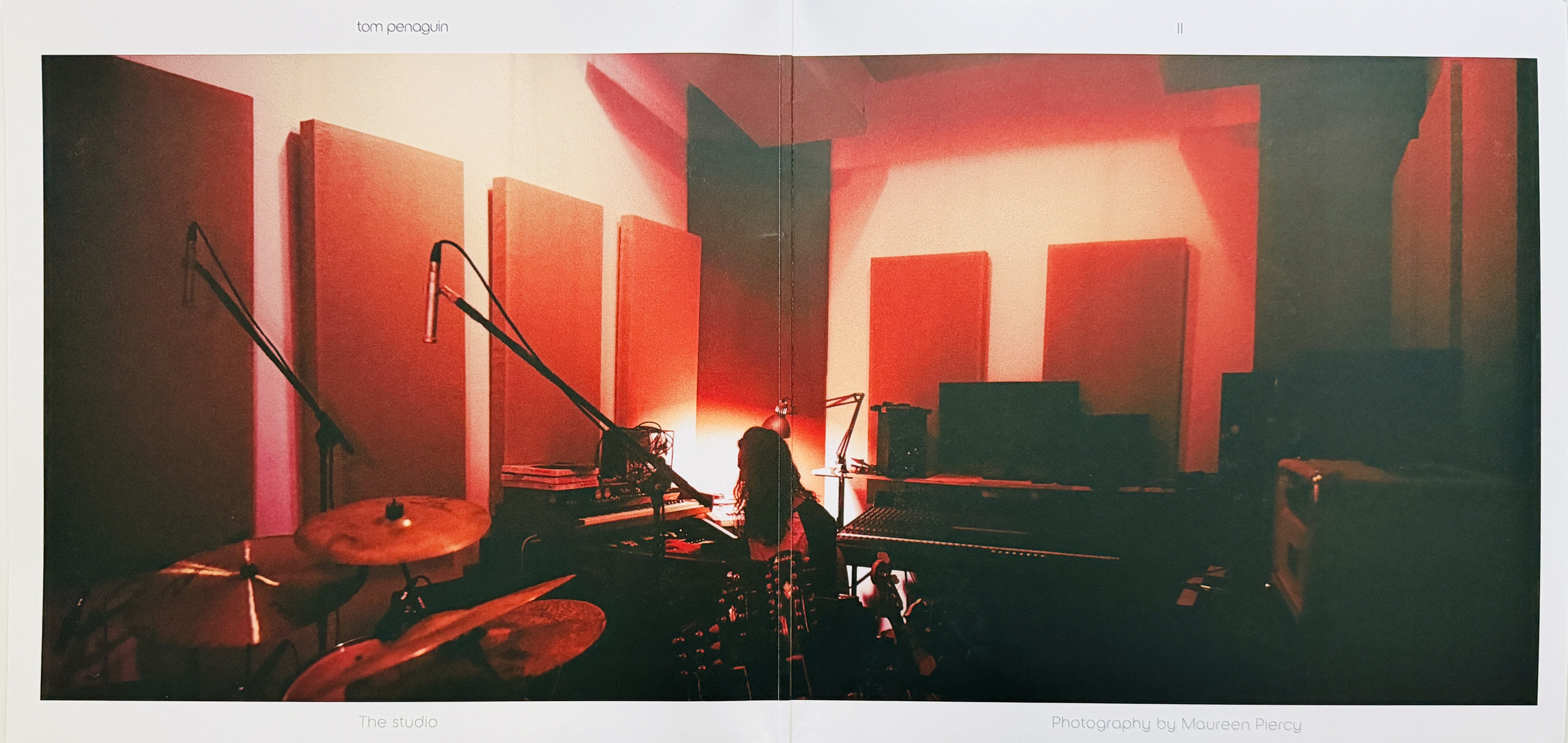
On Progressive Rock World, the French multi-instrumentalist Tom Penaguin is held in the highest regard; I consider him one of the most extraordinary and passionate contemporary interpreters of the Canterbury Scene, not only for the musical value of his works, but also for his human profile and the absolute dedication that led him to build an analog studio at home to record every instrument by himself.
On the site there are several articles and key in-depth pieces dedicated to him:
The review of the self-titled album "Tom Penaguin”, his true recording debut (released in 2024). I admit I approached the record with a touch of “snobbish skepticism”, only to end up in deep admiration for an essential masterpiece.
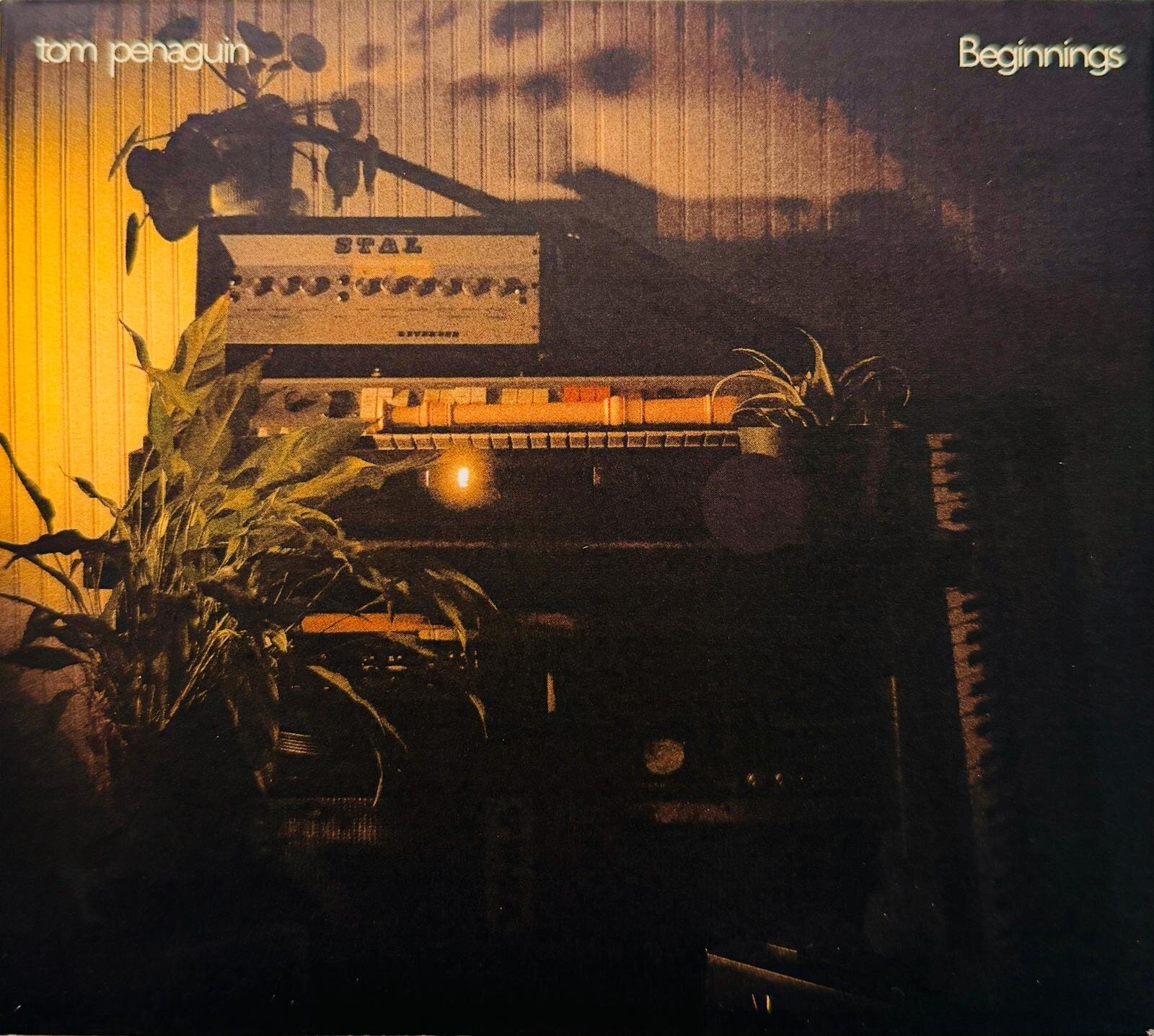
The review of the album "Beginnings", an archive project released in 2025, is basically a “prequel” that gathers the embryonic experiments written by the artist before the official debut, to show the public the “seeds” of his studio formation.
In the 2025 rankings I included him among the protagonists of the year with a sound I described as a “masterful ode to bands like Egg and National Health” with his classical-inspired patterns, glorious melodies, and long ’70s fusion improvisations.
Penaguin, together with other contemporary artists such as Zopp and Singlelito, is living proof that the Canterbury sound has by now become a universal, timeless language.
Tom Penaguin’s musical path is an example of dedication and perfectionism. Already at 17, he dreamed of recording an instrumental album inspired by Canterbury rock. It took about ten years of study, training, and the accumulation of analog gear in his home studio to make that dream come true. Before embarking on a solo career, he made a name for himself in the underground scene as guitarist of the psychedelic band Djiin and as keyboardist of Orgöne.
Like his successful 2024 debut album, “Tom Penaguin II” was conceived entirely as a solo project, a true “one-man band”. Tom composed, arranged, and recorded every single instrument – guitars, keyboards, bass, and acoustic drums – layering the tracks over about four months of isolated sessions.
This album continues and expands the formula of its predecessor, immersing the listener in the warm jazz-rock sonorities of the early ’70s. The organic, exquisitely analog sound is the result of an enviable collection of vintage instruments, among which stand out the Fender Rhodes Mark II electric piano, the Hohner Pianet C, and the Hammond L122 organ.
At the heart of this album is “The Ornamental Hermit Suite”, a majestic suite divided into four parts that fits perfectly into the tradition of the great progressive rock suites. It is not a cold imitation, but faithfully captures the adventurous, ironic, and technically complex spirit of Canterbury giants like Egg, National Health and Hatfield and the North. The keyboard work is strongly influenced by the style of Dave Stewart, while the bass lines are warm and full-bodied, enveloping. The guitar blends jazz-fusion phrasing with progressive-rock improvisations full of character, creating a fascinating mix.
Despite being played by a single person, the album conveys the energy and fluid interaction typical of a real live band, alternating fast, complex meters with moments of deep emotional charge, very moving. The record sits firmly within the early-’70s Canterbury jazz-rock and progressive-rock vein, combining extreme technical complexity with a great melodic freshness that sticks in your head. The guitar solos and phrases fuse the fluidity of jazz fusion with learned touches that recall the historic textures of Steve Hillage and Mike Oldfield, creating a unique atmosphere. The structures are dense with odd meters, constant time changes and sudden accelerations, yet balanced by sunny openings and deeply emotional moments, delivering an unforgettable musical journey.
Compared to the first album, although both records share the same analog backbone and the fully solitary composition, the main differences lie in the structure, the use of voice, and the shades of inspiration.
The first 2024 album consisted of five separate, independent tracks, including some long pieces. By contrast, the second chapter is built around a single monumental central work: “The Ornamental Hermit Suite”, divided into four movements linked to one another.
While the debut was an entirely instrumental record entrusted only to the dialogue between guitars and keyboards, Tom Penaguin II breaks that rule. The album in fact introduces vocal inserts for the first time (specifically in the first movement of the suite) with ethereal vocalises in full “Northettes” style, entrusted to the voice of Maureen Piercy.
If the 2024 work was more oriented toward the geometric coherence of National Health and the crooked organ craziness of Egg, the 2026 record shifts the center of gravity. The new compositions look to the more dreamy, ironic, and floating atmospheres typical of Hatfield and the North.
The first LP featured sharper peaks, free dissonances, and fragmented rhythmic passages. The second volume instead offers a smoother, more organic transition: the music starts from minimalist arpeggios, passes through organ drones, and flows into bright, fast, orchestral musical journeys.
“Didier Dandelion in the Year of the Great Winds” is an epic, nuanced progressive jazz-rock piece, drawing inspiration from the intricate textures of National Health and Hatfield and the North. It’s the song that opens the record and it’s also the longest. It begins quietly with a simple, hypnotic guitar arpeggio, which serves as the base to build a majestic arrangement. The second part suddenly picks up speed, introducing an enchanting interplay between the distorted keyboard and a tight rhythm section. Excellent is the melodic transition halfway through the song and the warm, pulsing bass groove.
“Mandatory Intermission” is a quirky, ironic instrumental interlude with a distinctly English flavor. It comes across as an ideal theatrical interval before the main suite. It highlights Penaguin’s more playful and satirical side, with sudden tempo variations and a generous use of the Fender Rhodes Mark II electric piano. Worth noting: the syncopated, lightning-fast keyboard runs in perfect Dave Stewart style.
“The Ornamental Hermit Suite, 1st Movement” represents avant-garde Canterbury in its purest form, enriched by marked vintage vocal influences. This is the piece that inaugurates the album’s majestic central suite. The unexpected element is the entrance of Maureen Piercy’s voice, performing ethereal, wordless vocalises. This choice is a clear and spot-on tribute to the “Northettes” (the famous vocal trio of Hatfield and the North). The interplay between Piercy’s vocalises and the analog organ drones is particularly effective.
The second movement of “The Ornamental Hermit Suite” is a jazz-fusion section dominated by the lead guitar. Penaguin shows incredible technique, creating undulating textures that evoke the psychedelic, dreamlike atmospheres of the early ’70s. At the center, a wonderful, very long guitar solo that strongly recalls Steve Hillage’s style.
The third movement of “The Ornamental Hermit Suite” is a progressive-rock piece marked by a dark, gloomy atmosphere, enriched by liturgical organ tones. It represents the most destabilizing and different segment of the suite. The track gradually unfolds around a dark, dissonant organ drone, evoking a mysterious atmosphere that recalls Egg’s more complex and jagged works, especially those from the “The Civil Surface” era. The handling of sonic tension and the heavy use of the Hammond organ are remarkable.
“The Ornamental Hermit Suite, 4th Movement” is the album’s melodic closing piece, a real gem of progressive symphonic rock. It begins with a melancholic, twilight mood, then opens into a bright, fast musical journey rich in tempo variations, culminating in a finale of rare beauty, where the guitars intertwine in an epic style that pays homage to Mike Oldfield’s Tubular Bells.
If the first album was a true demonstration of his technical ability in recreating a complex genre, Tom Penaguin II is a more mature, warm work centered on the suite-form. It’s an unmissable listen for all fans of classic progressive rock, vintage jazz-rock, and instrumental compositions rich in time changes, analog saturation, and refined solos.
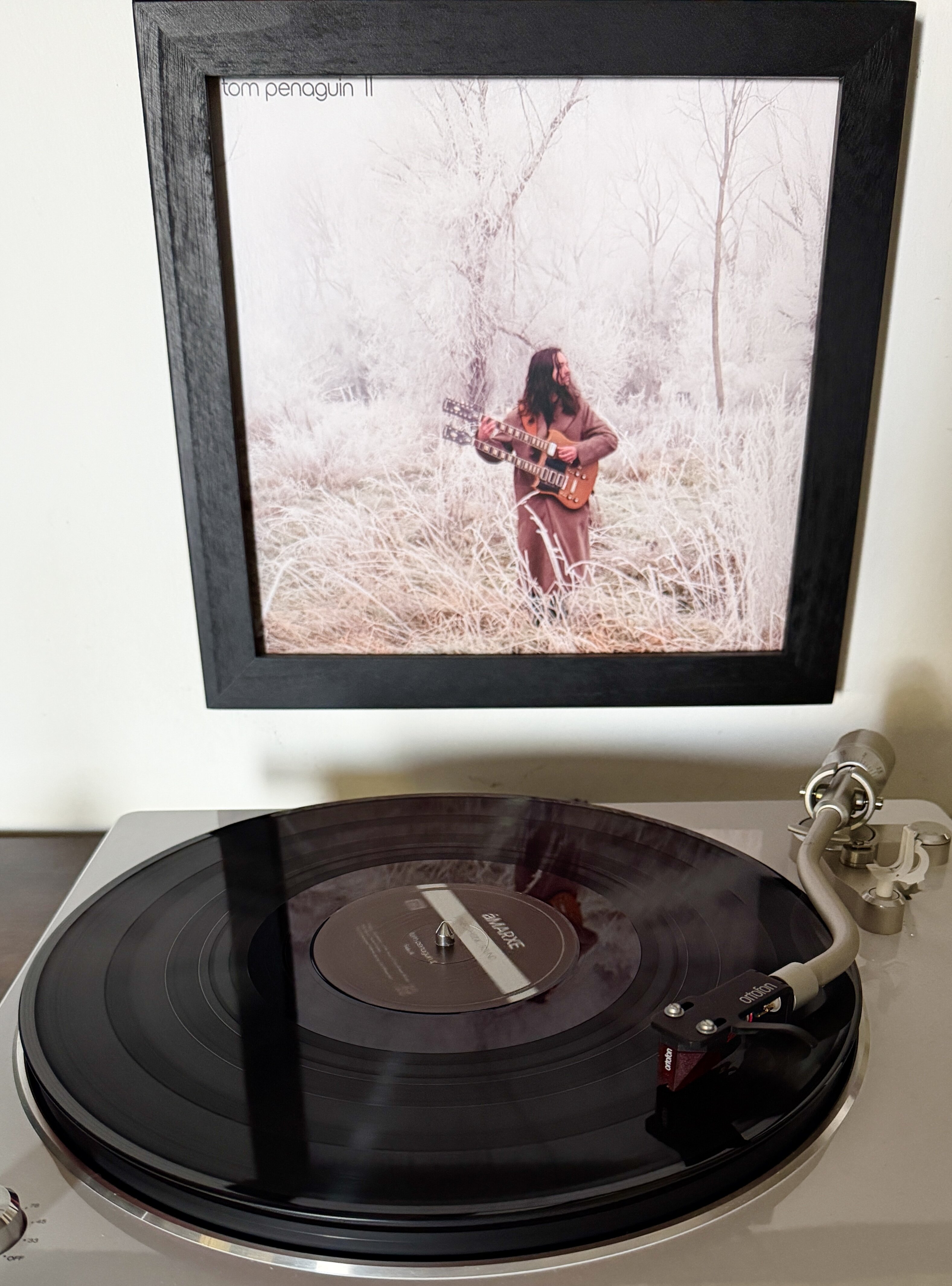
My Version
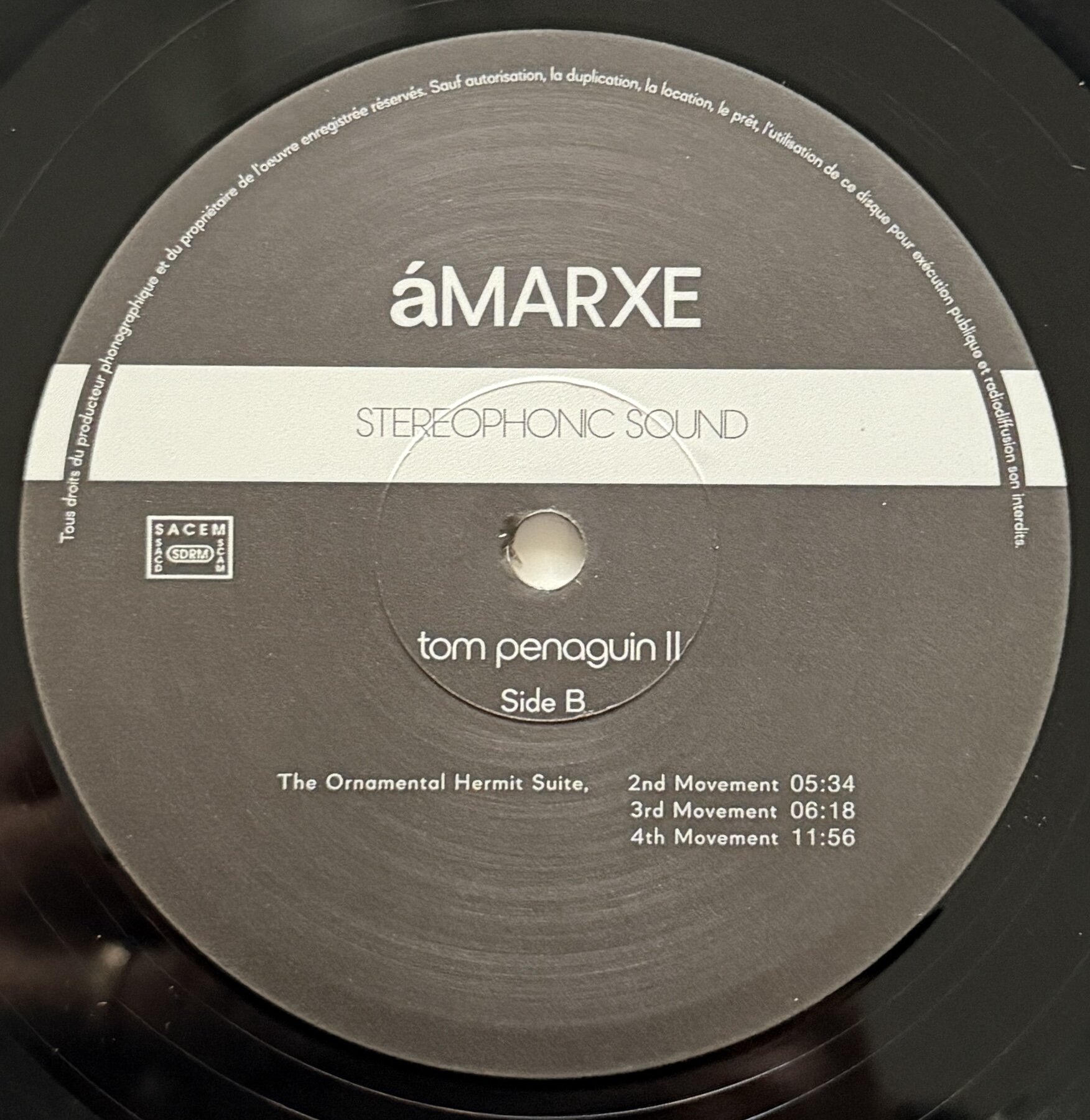
Label: áMARXE – 0626LP
Format: Vinyl, LP, Album
Country: Spain
Release: 2026
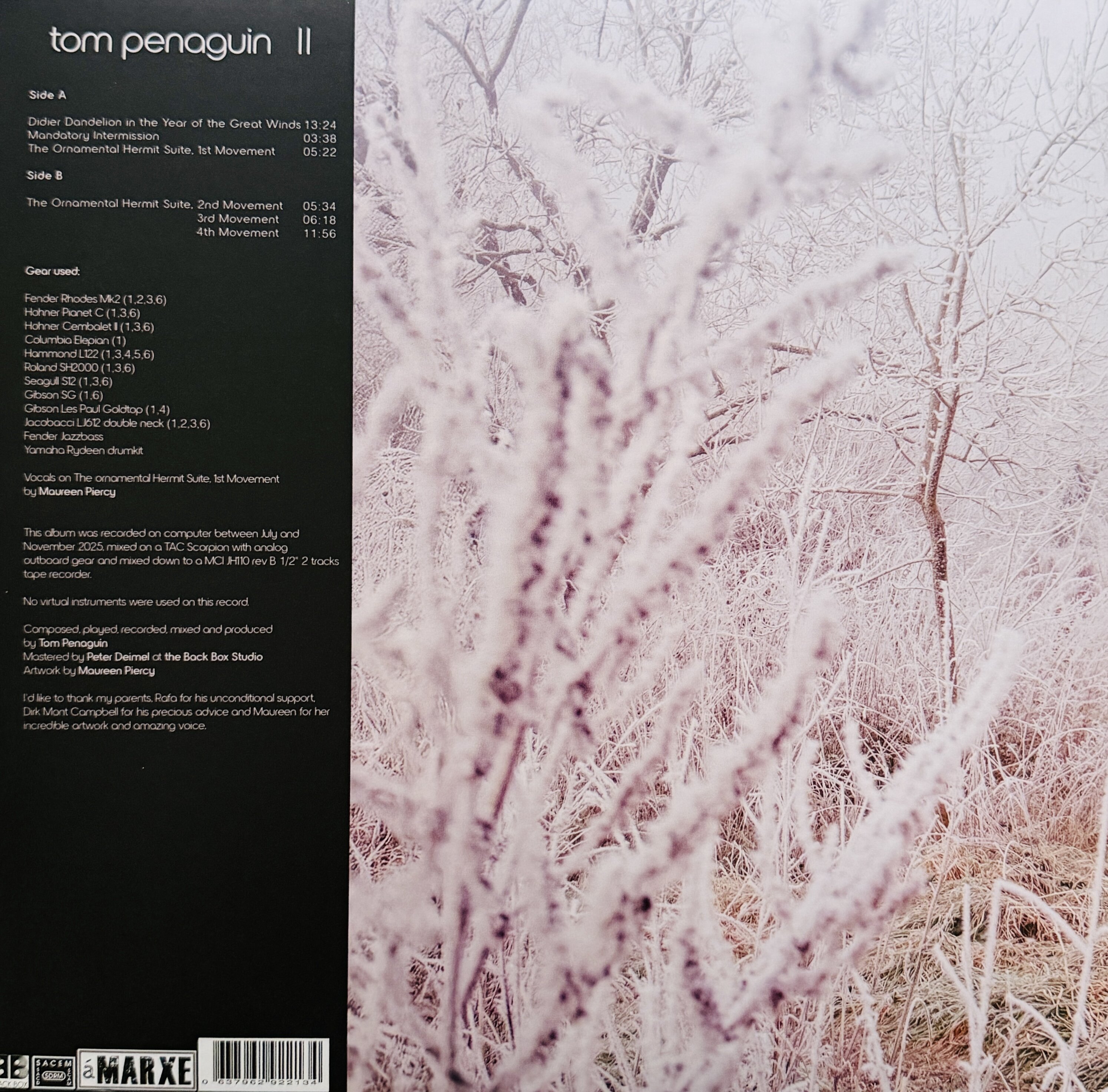
Tracklist
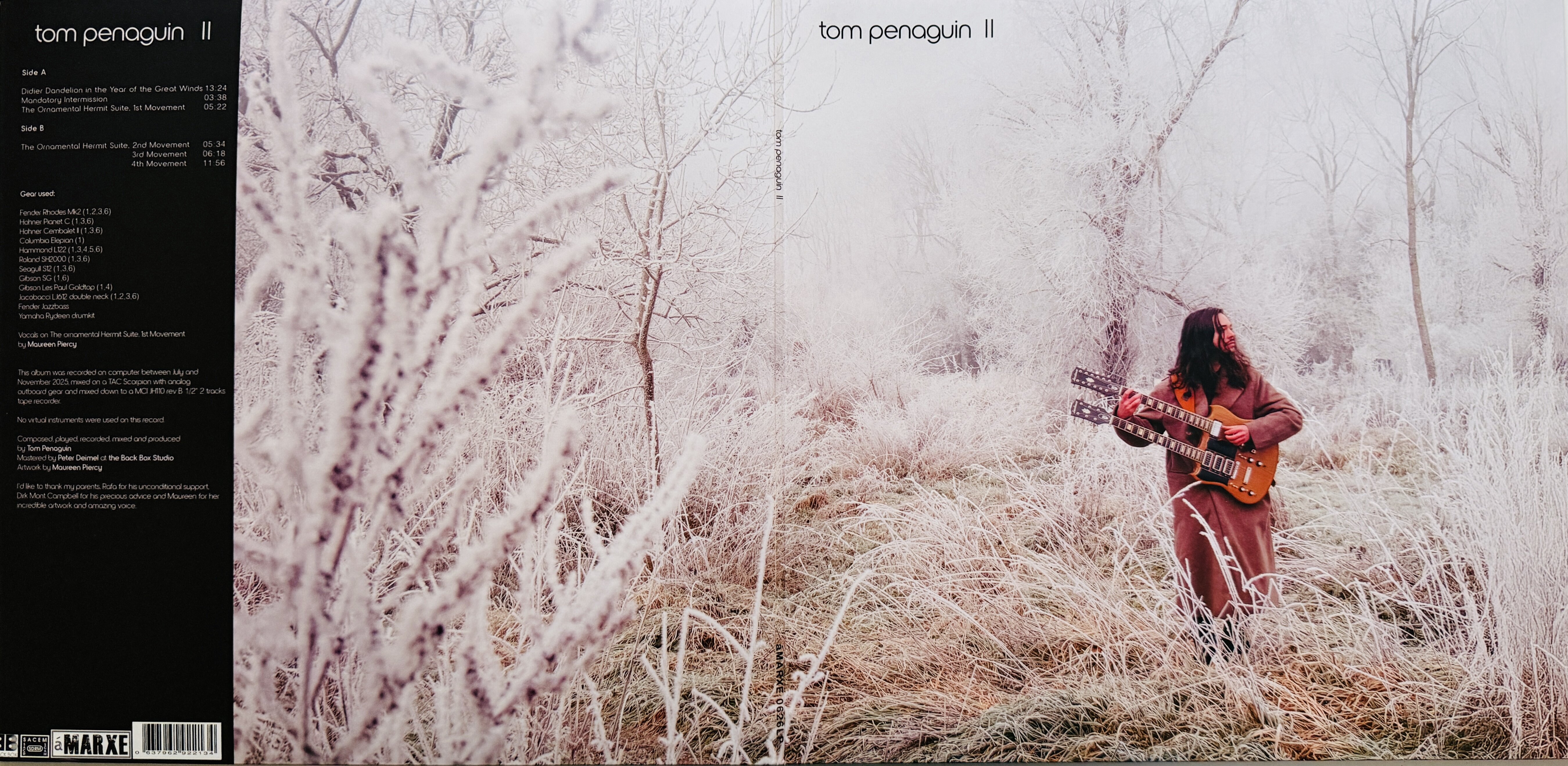
A1 Didier Dandelion In The Year Of The Great 13:24
A2 Mandatory Intermission 3:37
A3 The Ornamental Hermit Suite, 1st Movement 5:21
B1 The Ornamental Hermit Suite, 2nd Movement 5:35
B2 The Ornamental Hermit Suite, 3rd Movement 6:18
B3 The Ornamental Hermit Suite, 4th Movement 11:50
LineUp
Composed, played, recorded, mixed and produced by Tom Penaguin
Gear used:
Fender Rhodes Mk2 (1,2,3,6)
Hohner Pianet C (1,3,6)
Hohner Cembalet I (1,3,6)
Columbia Elepian (1)
Hammond L122 (1,3,4,5,6)
Roland SH2000 (1,3,6)
SeagullS12 (1,3,6)
Gibson SG (1,6)
Gibson Les Paul Goldtop (1,4)
Jacobacci LJ612 double neck (1,2,3,6)
Fender Jazzbass
Yamaha Rydeen drumkit
No virtual instruments were used on this record.
Vocals on 'The Ornamental Hermit Suite, 1st Movement' by Maureen Piercy
Listening links on the main streaming platforms at the following links:
Bandcamp: For full listening in high-resolution streaming and for digital or vinyl purchase, visit the official page of Tom Penaguin II on áMARXE Bandcamp.
Spotify: You can play the artist’s tracks directly via the official profile of Tom Penaguin on Spotify.
Note: All links to the musicians’ works are in the TAGS under the article title or on the "Artists"