
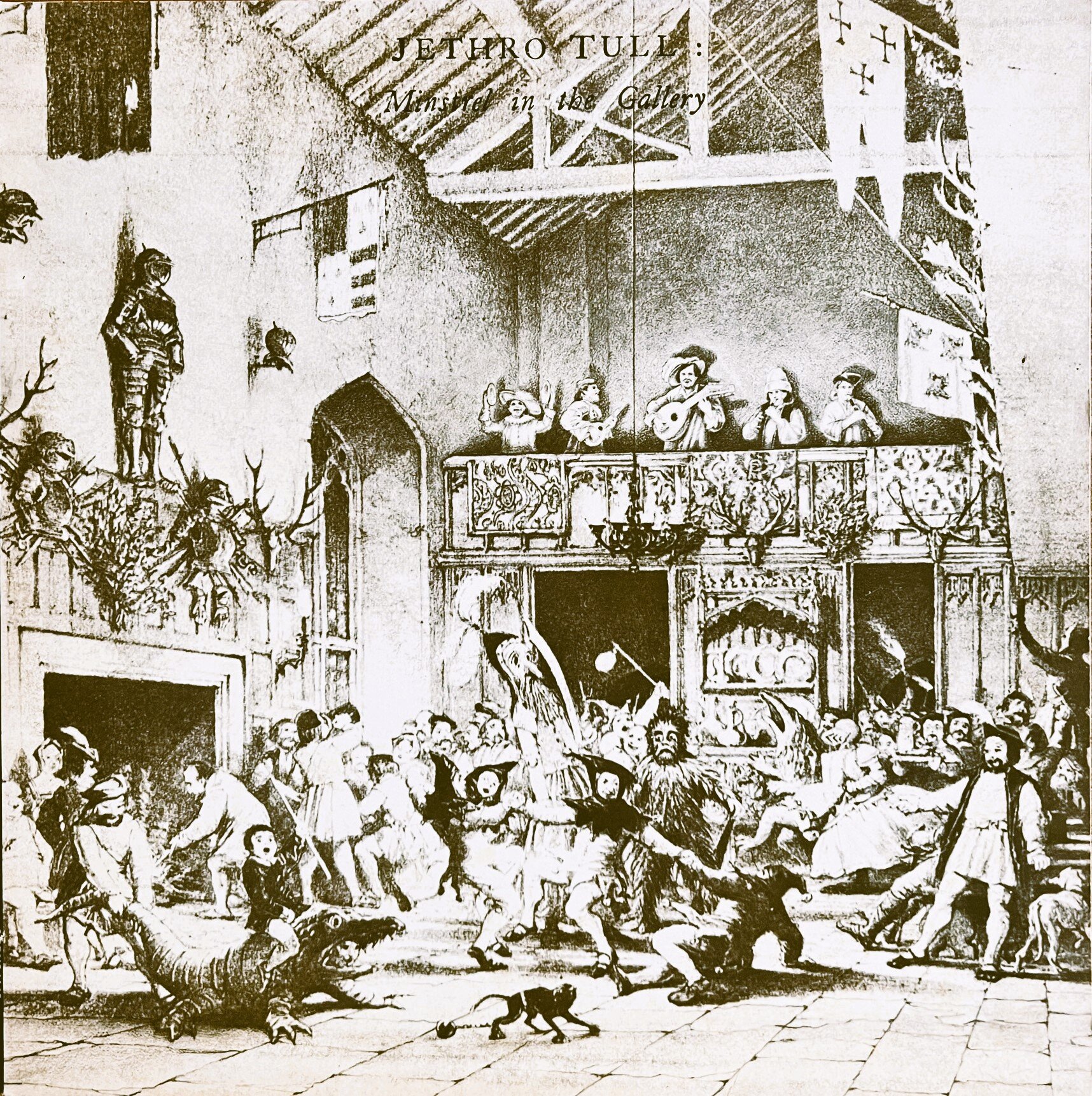
Minstrel in the Gallery by Jethro Tull, album from 1975.
I have spoken at length about the great Jethro Tull on many occasions in various reviews of their works including the most recent album Curious Ruminant, from 2025 and in the page dedicated to them “Jethro Tull: Rock, Folk, Blues and Anderson's Magic Flute”, but I like to recall that Jethro Tull are a British band founded in Blackpool in 1967 by Ian Anderson and led by him to this day.
The band takes its name from the pioneer of modern agriculture, the agronomist Jethro Tull, and is famous for its fusion of rock, folk, blues, and classical music, blending traditional and innovative sounds, with Anderson virtuously playing the flute and helping to define the band's sound.
Their music is characterized by the dominant presence of the transverse flute, played by the virtuoso leader Ian Anderson. After a debut marked by blues influences, Jethro Tull traversed the history of rock, experimenting with various genres: from folk rock to hard rock, from progressive rock to classical music.
A very long and brilliant career in Progressive Rock and Folk Rock with numerous lineup changes, an active band that continues to perform and release music.
Minstrel in the Gallery is a concept album that revolves around the metaphorical figure of the "minstrel" representing the modern artist and deals with the theme of detachment, observation, and solitude.
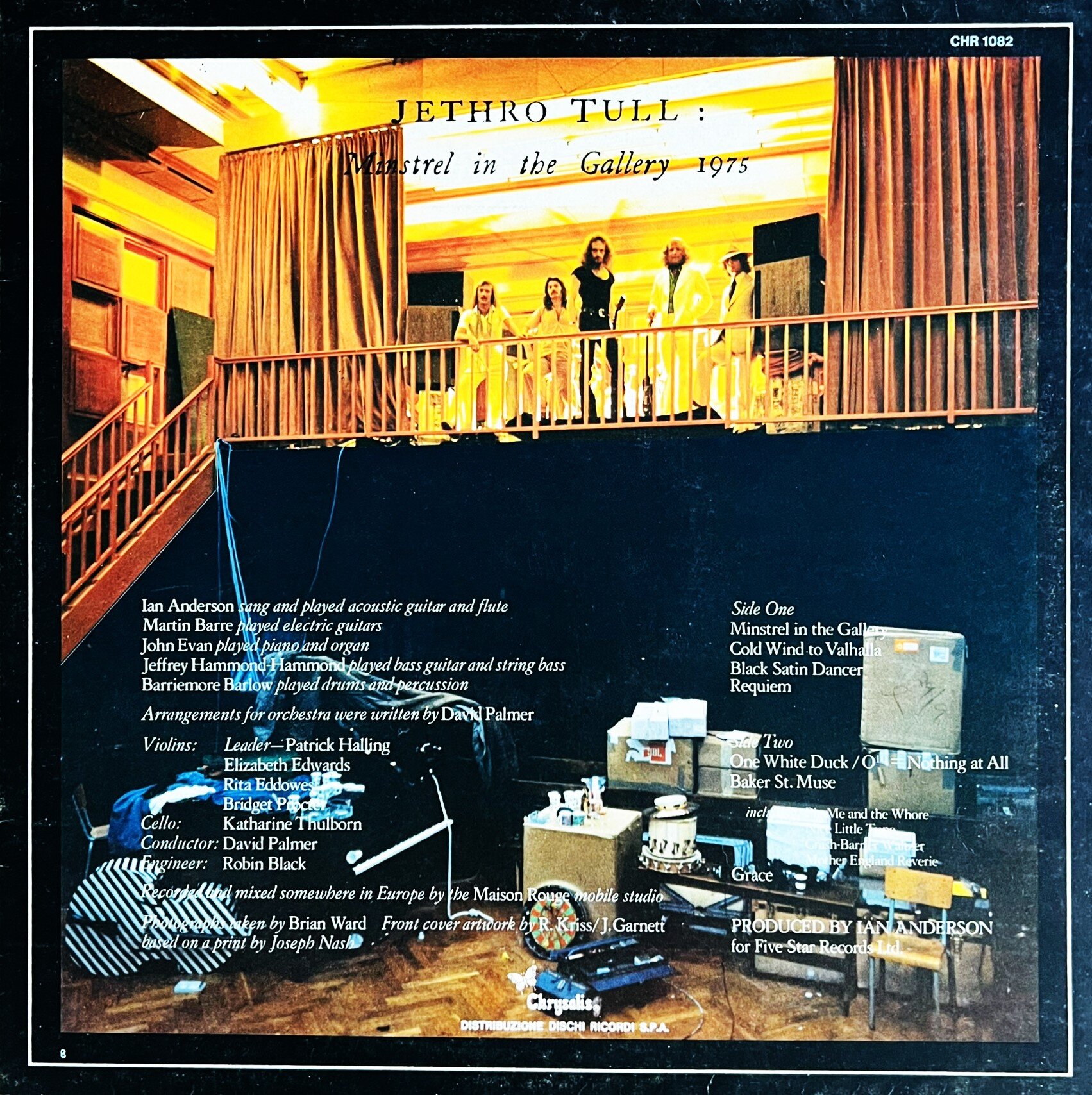
The Minstrel is described as an almost estranged observer of events, placing himself in a position of observation, elevated above the events themselves, and this is also represented on the album cover, which depicts a gallery of musicians, a raised balcony in the halls of medieval castles, as shown on the cover.
According to Ian Anderson this is his position as a rock musician: the artist is "up high", looks at the crowd from the outside and is not part of it, the minstrel is not a cheerful entertainer, but a cynical and detached chronicler and often a critic of society and urban life. Inevitably, this refers to an autobiographical dimension, it is an intimate and personal vision, also due to events in Anderson's life, who at that time was experiencing a divorce from his first wife and the intense pressure of the great fame achieved with the recent masterpieces.
The lyrics reflect the feeling of isolation, paradoxically given by life "on the road" and in hotels, a gilded cage. The concept is also developed through the music, not just the lyrics. Strings and acoustic guitars recall Elizabethan England, with a medieval tone, evoking a golden age of simplicity and honor, ideals that contrast with aggressive electric rock and lyrics that speak of dirty streets, trains, and modern decay, suggesting that the "minstrel" is now an anachronism in an industrial world.
The Electric/Acoustic dualism is present in the structure of the tracks with frequent transitions between moments of extreme acoustic delicacy and sudden hard rock explosions.
The portrait of an artist who, despite being at the center of attention, chooses to retreat into his private "gallery" to observe the world.
Great fusion of folk and rock, fantastic orchestration, top-level production even in this original 1975 vinyl copy that sounds great (which is why I haven't yet bought the Steven Wilson Remix), a concept album structured almost like a suite with acoustic and folk elements and rock explosions.
The atmosphere is melancholic and reflective, with Anderson's unmistakable flute creating an engaging atmosphere, complex arrangements performed with great instrumental technique.
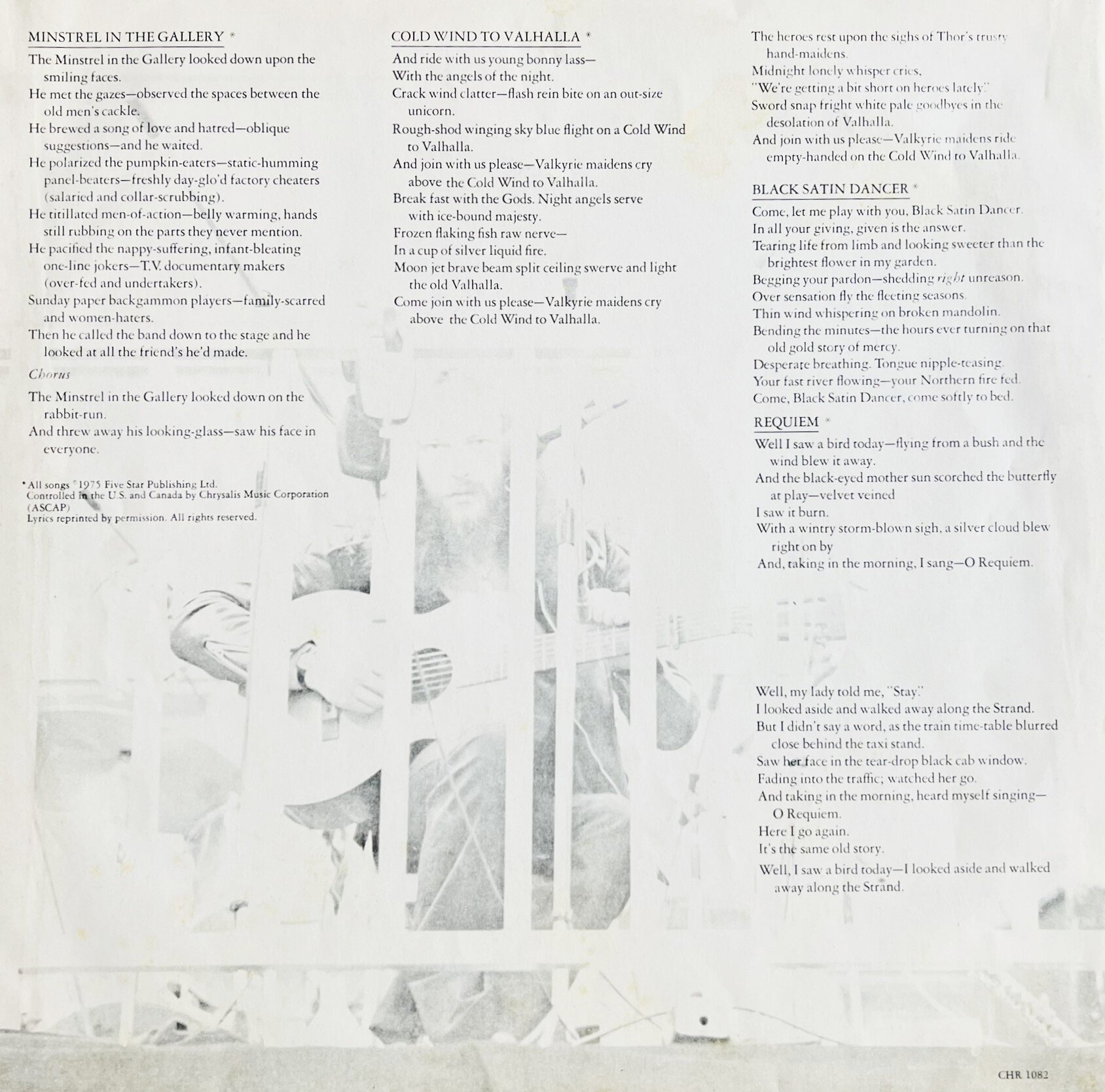
- Minstrel in the Gallery is one of the strongest compositions on the record and by the band, with an acoustic intro and a driving hard rock section.
- Cold Wind to Valhalla is an energetic track with great vocal performances, with a theatrical tone, by Ian Anderson and the great lead guitar of Martin Barre.
- Black Satin Dancer is a complex track, with strings and virtuosic instrumental sections with the best guitar solo on the album.
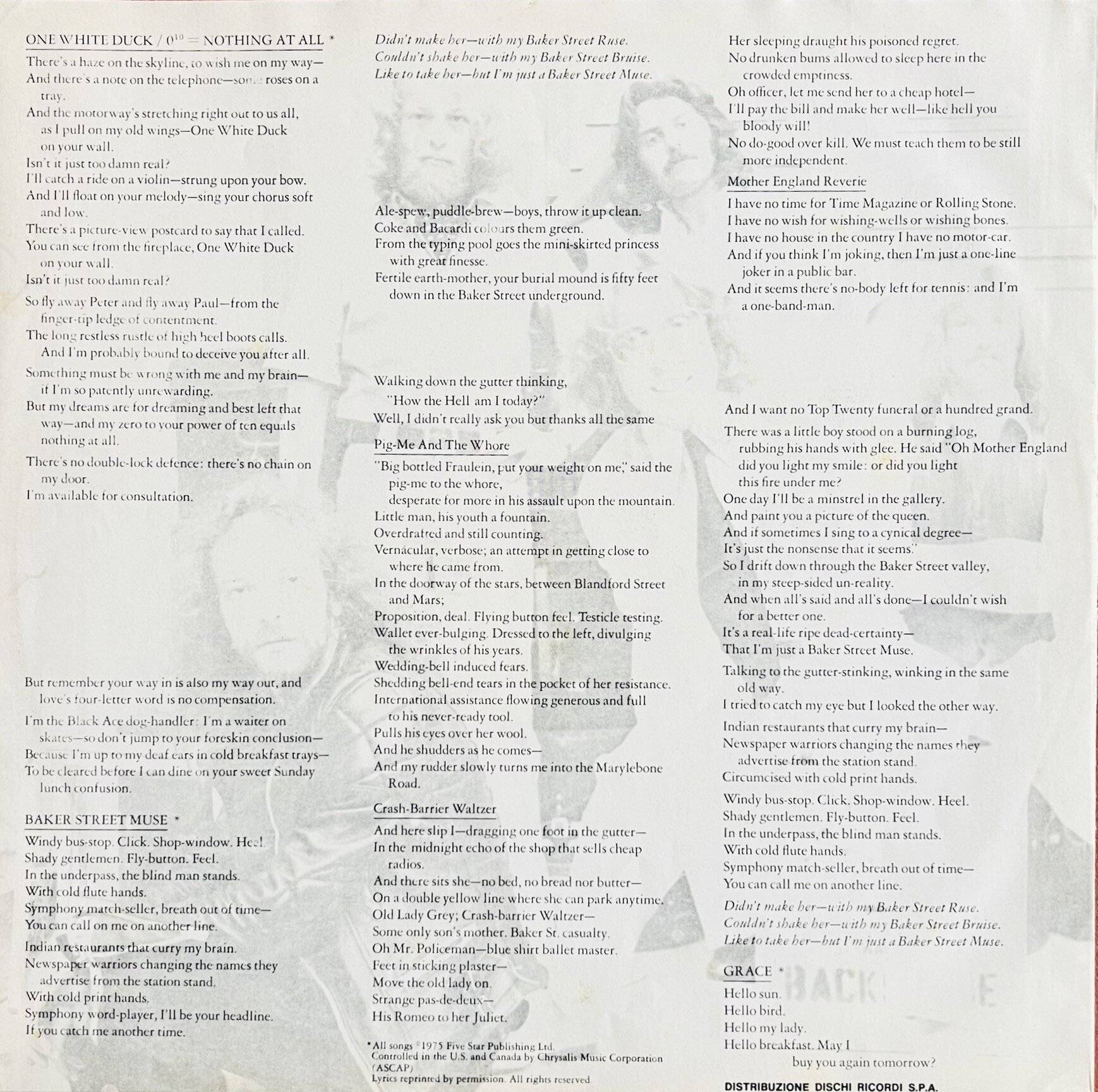
- One White Duck / 0¹⁰ = Nothing at All is a beautiful acoustic ballad with an engaging melody and beautiful string arrangements by David Palmer.
- Baker St. Muse is the suite of the album, lasting over 16 minutes, a masterpiece track, the last great progressive "epic" in the studio by the band in the '70s.
It is a medley composed of four sections (six, if you consider the reprises of the main theme) that flow without interruption:
o Baker St. Muse which introduces the main theme and describes the detached observation of urban life in Baker Street.
o Pig-Me and the Whore which is a more rhythmic section that tells of the encounter between an awkward man ("pig-me") and a prostitute in an alley.
o Nice Little Tune which is an instrumental interlude
o Crash-Barrier Waltzer, a very touching section that describes a homeless woman sleeping on the street and the intervention of a policeman who moves her away.
o Mother England Reverie, a melancholic section dealing with the loneliness experienced by the protagonist.
o Baker St. Muse (Reprise) which returns to the initial theme and reaffirms the concept of the author as an external observer
- Grace closes the album and despite its brevity, has great significance. Only 37 seconds with lyrics that are a joyful greeting and say "Hello sun, hello bird, hello my lady, hello breakfast. May I buy you again tomorrow?", described by Ian Anderson as "a thank you, a secular prayer (a 'grace', in fact) for the small daily fortunes.” The "minstrel" returns to reality and rediscovers appreciation for the simple things that depression had prevented him from enjoying.
It is the first Jethro Tull album to be recorded outside the United Kingdom, the recordings took place in the band's mobile studio, called Maison Rouge Mobile Studio, at the Prince of Wales Hotel in Monte Carlo, where the mobile studio was parked for the occasion.
Following this album, Jeffrey Hammond left the group to return to his previous activity, painting. Jeffrey considered painting his "first love", in fact before joining the band in 1971 for the album Aqualung, he had attended art school and felt that his time in the rock world had come to an end. Not being a professionally trained musician, Hammond found it extremely difficult to memorize and perform the complex musical structures composed by Ian Anderson. He himself admitted that he often felt like "the lowest common denominator" of the group in terms of technical ability. Moreover, after five years of intense world tours, he was tired of the rockstar lifestyle and the constant creative and professional demands of the band's leader. To mark his definitive exit from the scene, after the last concert of 1975, Jeffrey burned his iconic black and white striped stage suit (zebra style) and never played bass in public again.
Ian Anderson tried to convince him to return in the following years (particularly in the mid-1980s) but Hammond always refused, no longer feeling up to the technical level of the group and was definitively replaced by John Glascock, a professional bassist
In my opinion, this is one of the most beautiful Jethro Tull albums, a truly special album.
Note: All links to the musicians' works are in the TAGS under the article title or on the "Artists" page
Tracklist
1. Minstrel in the Gallery (8:13)
2. Cold Wind to Valhalla (4:21)
3. Black Satin Dancer (6:53)
4. Requiem (3:45)
5. One White Duck / 0^10 = Nothing at All (4:39)
6. Baker St. Muse (16:42)
- a. Pig-Me and the Whore
- b. Nice Little Tune
- c. Crash-Barrier Waltzer
- d. Mother England Reverie
7. Grace (0:37)
Duration 45:10
LineUp
- Ian Anderson - vocals, flute, acoustic guitar, producer
- Martin Barre - electric guitar
- John Evan - piano, organ
- Jeffrey Hammond - bass, double bass
- Barriemore Barlow - drums, percussion
With:
- David Palmer - arranger and conductor
- The London Philomusica (members):
- Patrick Halling - violin, leader
- Bridget Procter - violin
- Elizabeth Edwards - violin
- Rita Eddowes - violin
- Katharine Thulborn - cello