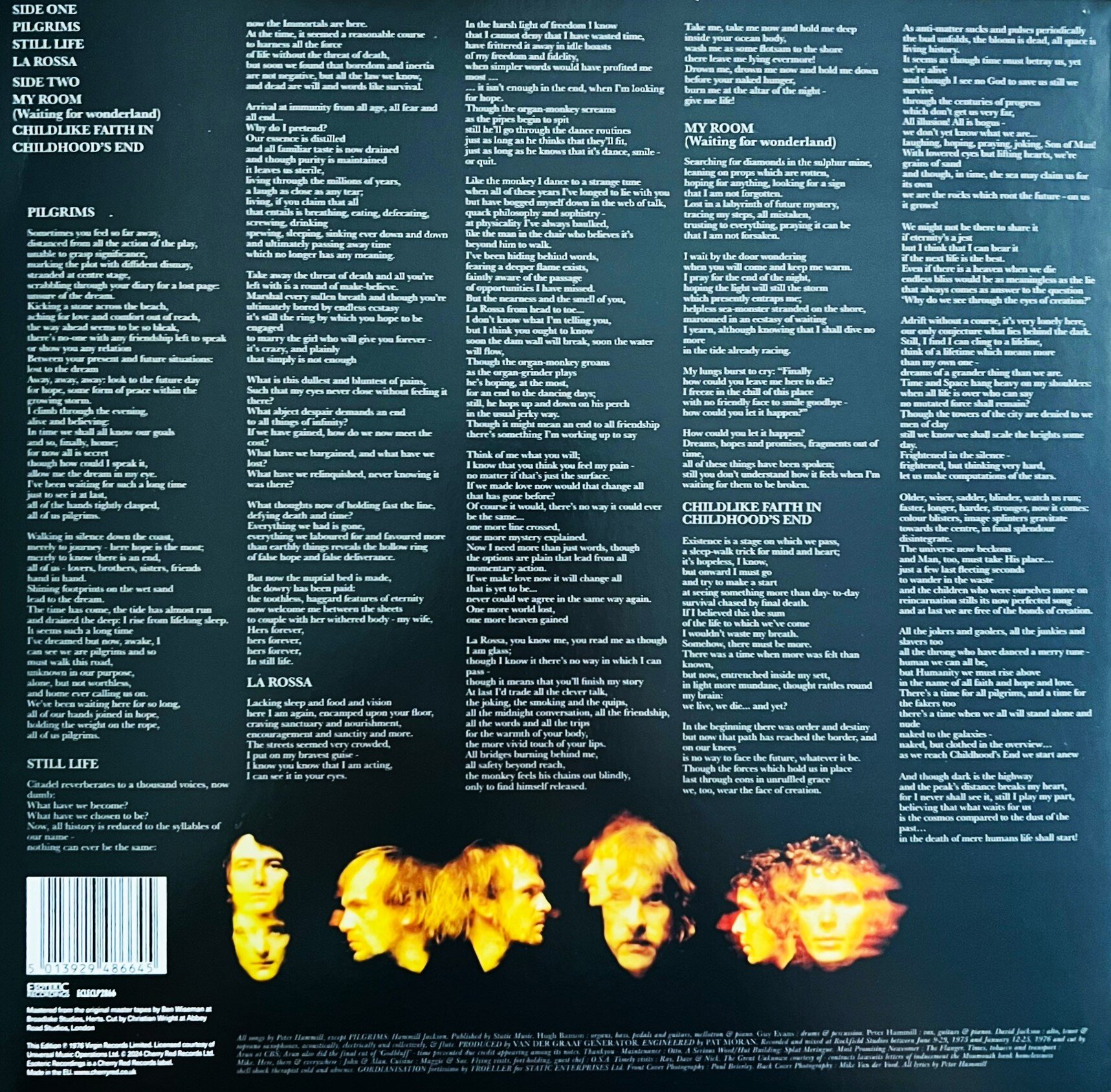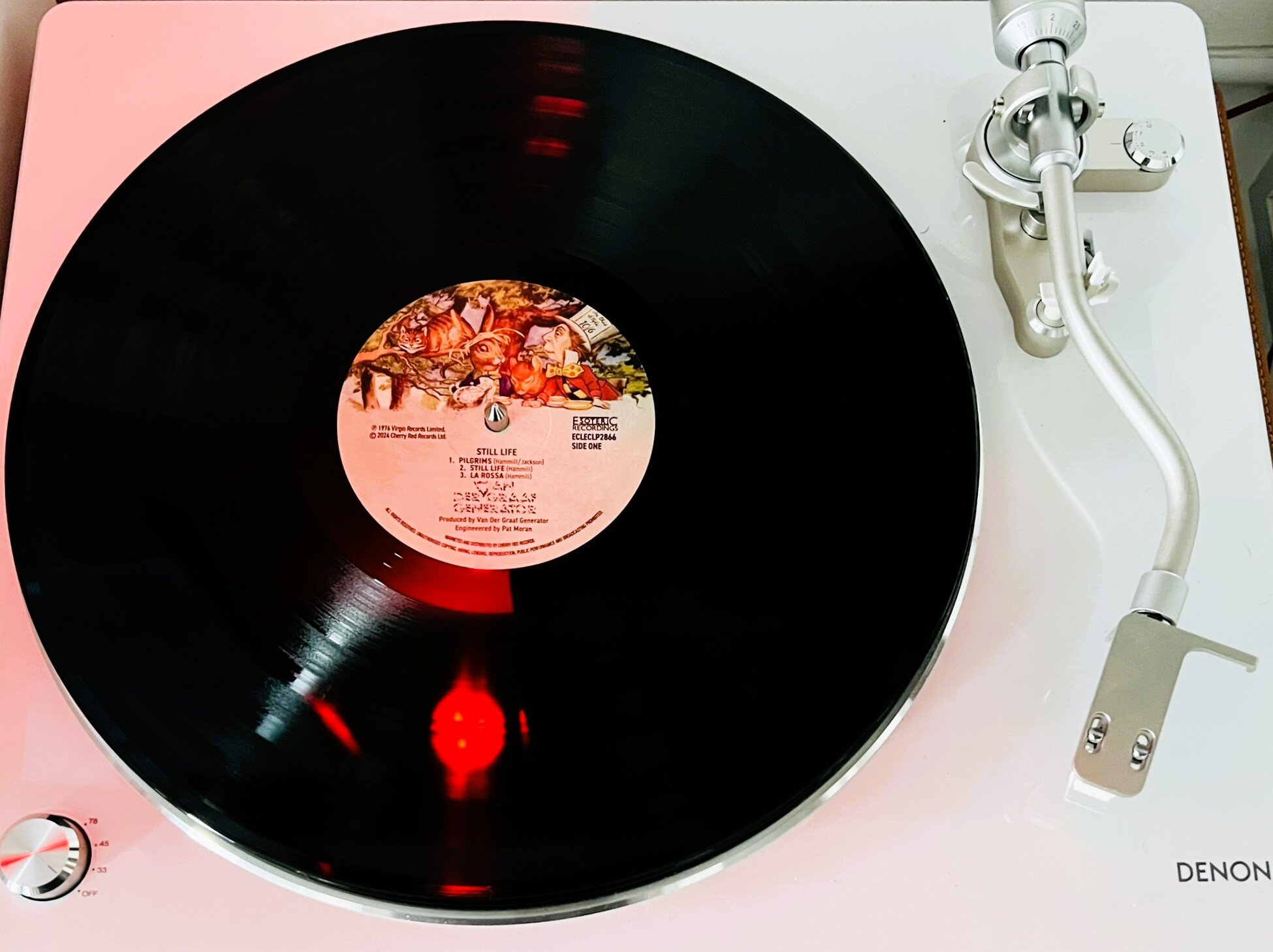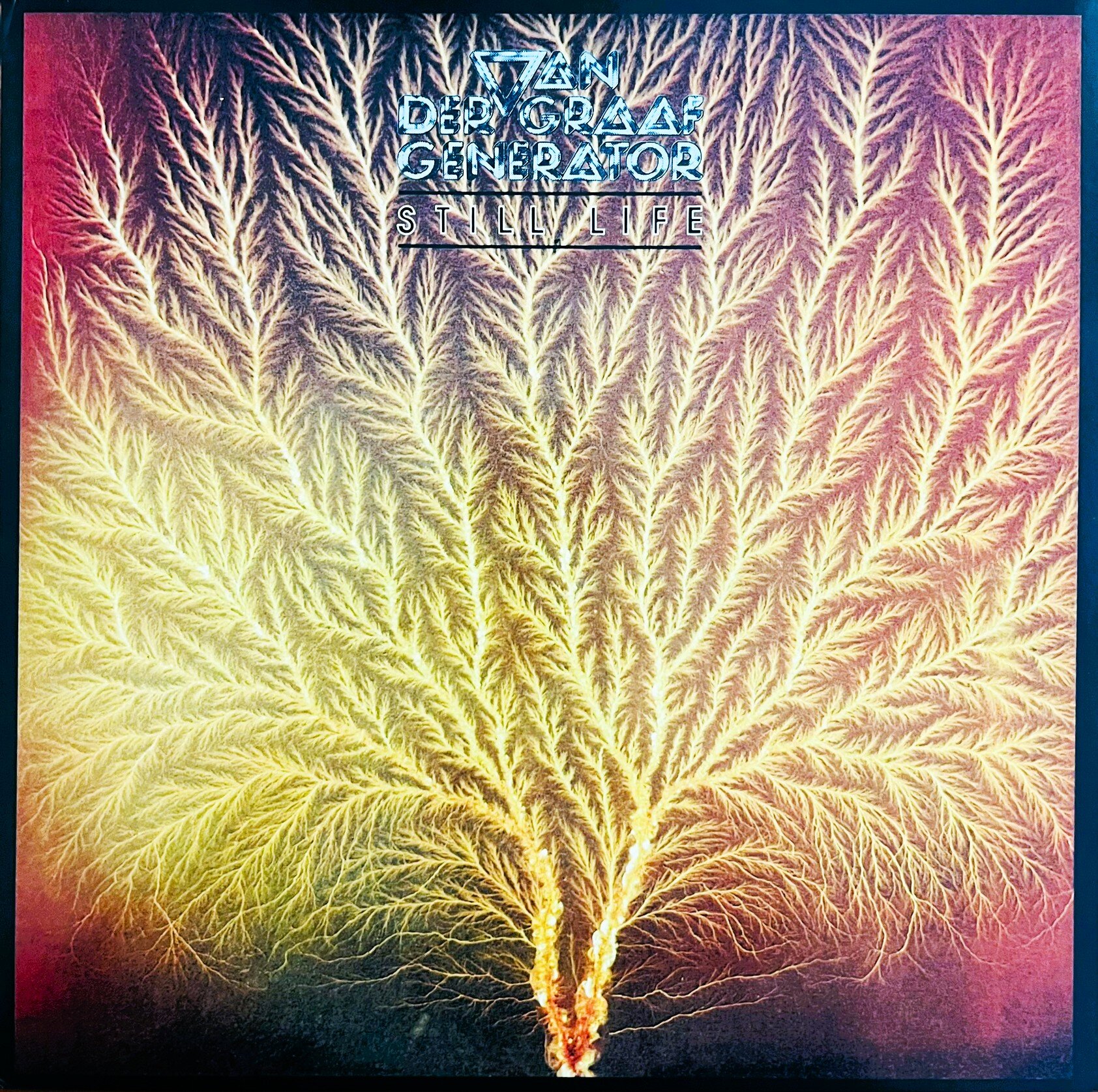
Still Life by Van der Graaf Generator, released in 1976.
I've discussed Peter Hammill and Van der Graaf Generator, of which he was a founder, at length in my article "The Unique Style of Van der Graaf Generator: Prog Rock Between Obscurity and Philosophy" and in my reviews of Hammill's albums.
Still Life is one of their absolute masterpieces and an essential album for progressive rock, a milestone.
It's their second album after the 1975 reunion, released between Godbluff of the same year and World Record of 1976.
The lineup remained unchanged from the previous Godbluff, retaining the "classic" quartet of Peter Hammill, Hugh Banton, Guy Evans, and David Jackson. The only change concerned Hugh Banton's instrumental approach, which at that time began heavily incorporating custom organs to compensate for the lack of a full-time bassist.
Banton heavily modified his instruments; his Hammond organ and Farfisa models were modified to achieve unique distorted and orchestral sounds, often connected to custom amplification systems.
Only after the album's release did radical changes begin that would transform the band between late 1976 and 1977: immediately after the album's promotional tour and the recording of the subsequent World Record (October 1976), Hugh Banton left the group to pursue a career as an electronic organ builder. He parlayed his technical expertise into a successful career as an organ builder and designer, founding his own company, The Organ Workshop, combining computer science with classical organ building and using a technology called "physical modeling digital synthesis," designed to faithfully replicate the complex and rich sound of real pipe organs, but in more versatile and compact digital formats. Today, Hugh Banton is considered one of the world's leading experts in the field of digital liturgical and concert organs.
David Jackson left shortly thereafter, in early 1977, due to internal tensions and logistical problems. The band's transformation culminated in their new name, "Van der Graaf," when Nic Potter (returning to the group after several years) and Graham Smith (violin) joined.
A masterpiece in every sense, the album's title itself is a conceptual masterpiece: the literal meaning refers to the pictorial genre of "Still Life," but the title plays on the ambiguity of the words: "Still" and "Life." The idea of something alive, or once alive, but portrayed in a state of immobility evokes a deeper meaning, Peter Hammill's vision of immortality, the "still life" that is the condition of those who have conquered death: if life no longer has an end, it loses its dynamism, its urgency, and its evolution, and "Still Life" becomes an eternal stasis, a condemnation where existence is crystallized, devoid of purpose and change, making immortality indistinguishable from death itself.
Three main themes revolve around this concept, and, as we'll see later, the artwork itself is a splendid representation of them:
The paradox of immortality: In the title track, Peter Hammill explores the concept of a society that has conquered death. Far from being a gift, immortality is described as a condemnation to boredom, inertia, and sterility. Without an end, life loses its flavor and urgency, becoming a "still life."
The quest for transcendence: Tracks like "Pilgrims" and the final suite "Childlike Faith in Childhood's End" (inspired by Arthur C. Clarke's novel) balance pessimism with a more hopeful vision. Here, humanity is seen as constantly evolving, like pilgrims seeking to overcome their physical and mental limitations to find a higher purpose, accepting death as an integral part of the life cycle.
Emotion and desire: Tracks like "La Rossa" and "My Room (Waiting for Wonderland)" bring the concept to a more intimate and human level, exploring the tension between the platonic and the sexual, the desire for connection, and the melancholy of loss.
Musically, the album is characterized by solemn atmospheres, with moments of almost religious calm thanks to Hugh Banton's gothic, liturgical organ, and by alternating moods ranging from a subdued tone with piano and light winds to explosive, sometimes angry, instrumental sections.
Banton uses the organ's pedals to cover the low frequencies, creating a deep, almost percussive soundscape, and David Jackson's saxophones are electrified or played with two instruments simultaneously, with dissonant harmonies replacing the guitar riffs. Peter Hammill's performance is extraordinary, melodic yet theatrical, ranging from a whisper to a desperate cry. This progressive rock borders on jazz-rock, with Guy Evans's rhythms.
- "Pilgrims" opens the album with a solemn organ and a pastoral tone, evolving into a majestic crescendo with David Jackson's melodic and powerful saxophone work.
- "Still Life," the title track, is one of Peter Hammill's darkest and most philosophical compositions, characterized by a suspended atmosphere and his initially whispered voice.
- "La Rossa" is an intense track, a frenetic suite that alternates moments of calm with violent explosions, with Guy Evans at his best.
- "My Room (Waiting for Wonderland)" is a melancholic ballad with extraordinary piano and saxophone, with a jazzy feel. It's an intimate piece with a more linear structure that allows for an exceptional vocal performance.
- "Childlike Faith in Childhood's End" is the album's epic closing track, one of the pinnacles of the prog genre as a whole, a complex suite with liturgical organs, distorted sax riffs, radical tempo changes, and a triumphant finale.
The artwork isn't a painting or an abstract photograph, but features a Lichtenberg figure, in a photograph taken by Paul Brierley of an electrical discharge captured in acrylic, representing the idea of something alive, like electricity, rendered eternal and immobile, a perfect visual representation of the album's title and concept.
"Still Life" is now a classic, a benchmark of progressive rock for its ability to unite poetry and music, a key work by Van der Graaf Generator.
Note: All links to the musicians' works are in the TAGS under the article title or on the "Artists" page.
Tracklist
1. Pilgrims (7:07)
2. Still Life (7:20)
3. La Rossa (9:47)
4. My Room (Waiting for Wonderland) (8:09)
5. Childlike Faith in Childhood's End (12:20)
Duration 44:43
LineUp
- Peter Hammill - vocals, guitar, piano
- Hugh Banton - organs, bass and bass pedals, Mellotron, piano
- David Jackson - acoustic and electric alto, tenor, and soprano saxophones, flute
- Guy Evans - drums and percussion