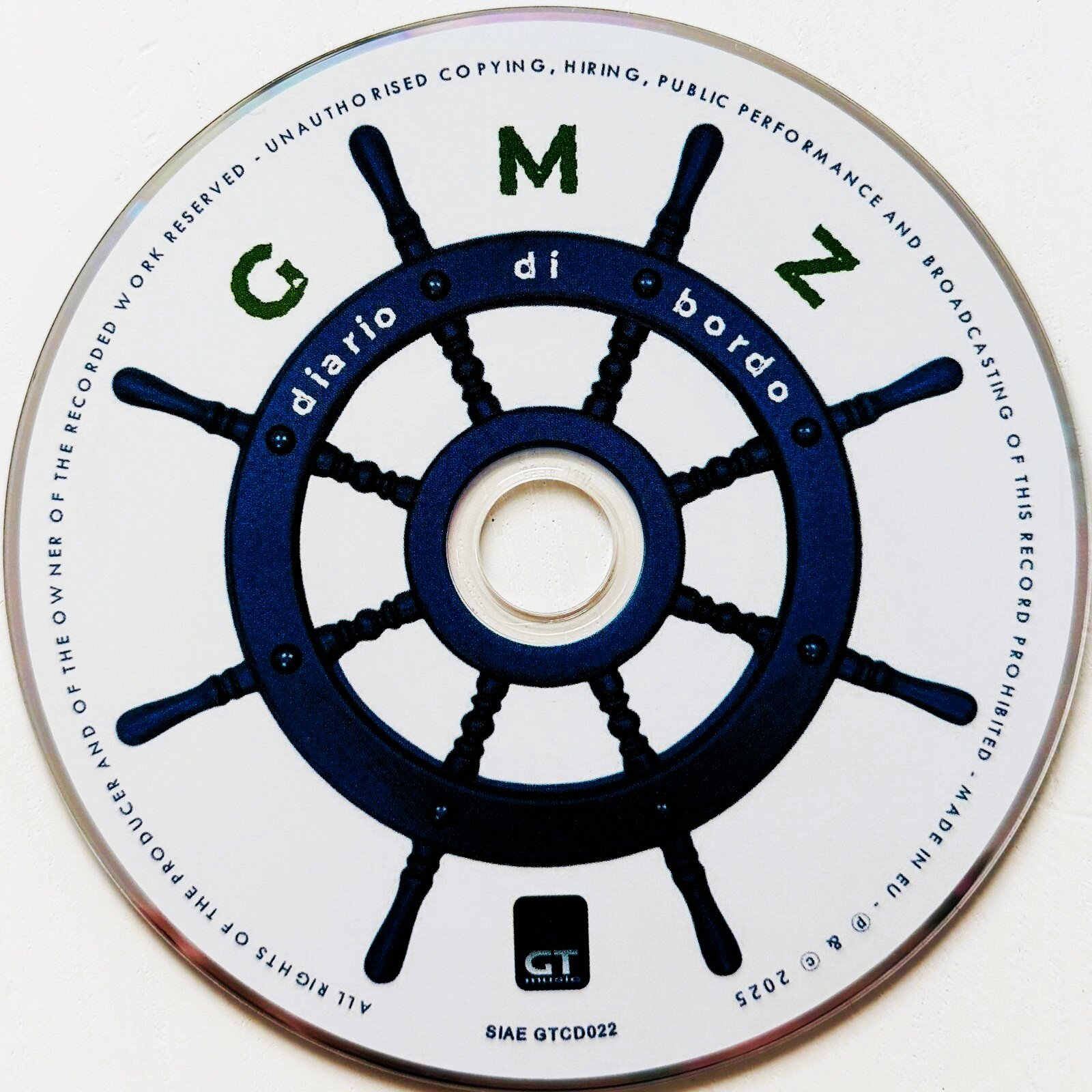

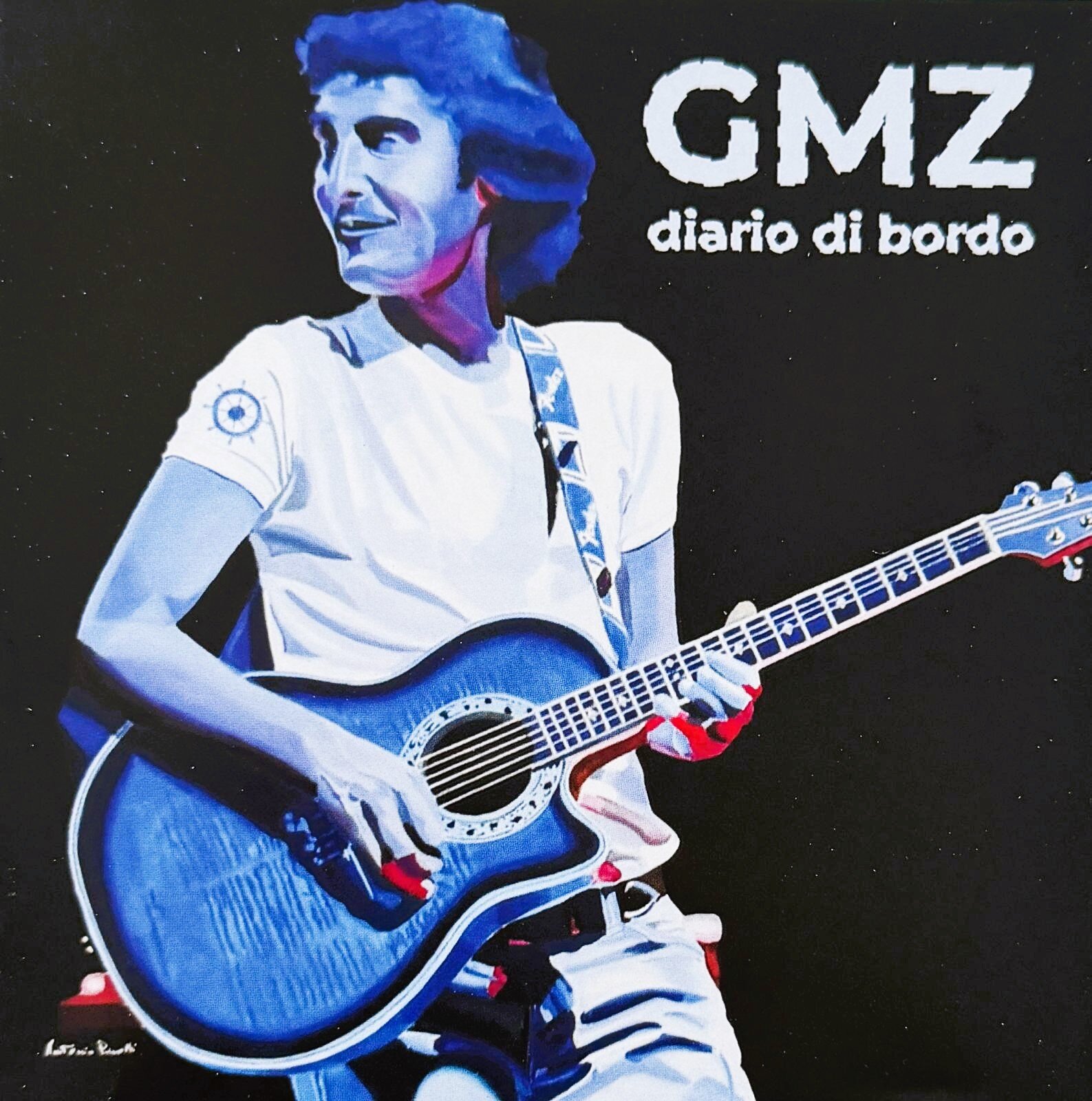
Diario di Bordo by Gianmaria Zanier, from 2025.
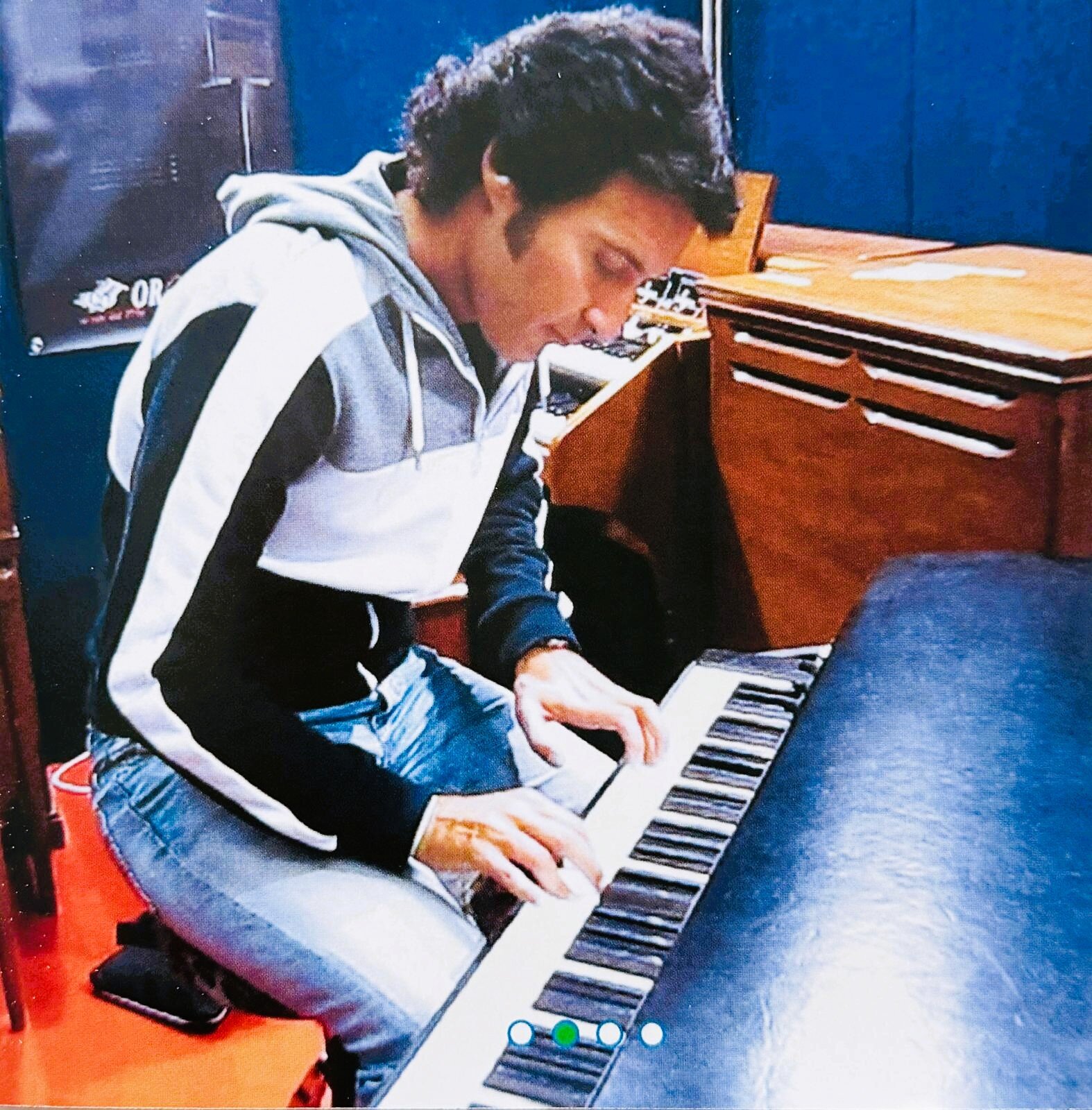
Gianmaria Zanier is a multifaceted Italian professional born in Udine and educated in music, journalism, and teaching. He graduated from the University of Bologna in "Methodology of Criticism" and obtained a Master's degree in "Audiovisual Ideation and Production" from the University of Milan and attended the "A. Vivaldi" Conservatory. In addition to teaching in high schools, he is a musician, singer-songwriter, composer, and journalist.
He is known for being the creator and host of the radio show "PROG & Dintorni" on Radio Vertigo 1, where he focuses on the spread of all kinds of music, including singer-songwriters, soundtracks, and quality pop. His focus, which I particularly admire, is on Italian and international progressive music, of which he is a passionate enthusiast and expert, providing fascinating insights. He also works as a freelance journalist, collaborating with various publications and covering current affairs and culture.
In recent years, he has felt the need to return to an active role in the music world, and thanks to his many contacts with outstanding musicians, whom he has involved in the project as described in more detail below and in the liner notes, he has released the album "Diario di Bordo."
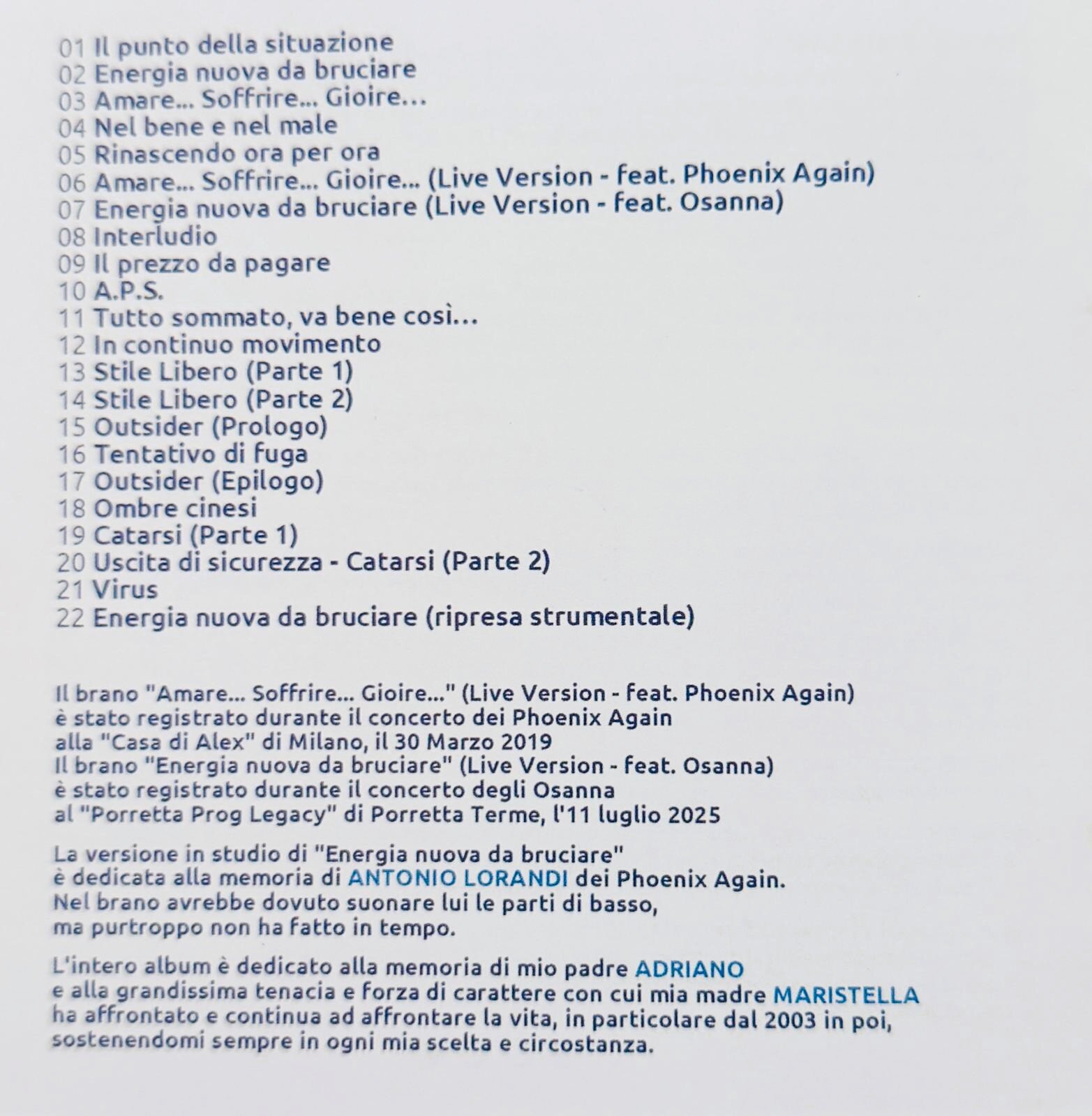
The album, a collection of 22 songs, both vocals and instrumental, retraces Gianmaria Zanier's personal and artistic history. It was released on the G.T. Music Distribution and will be available in December 2025.
A first, heartfelt introduction to the album is already present in the liner notes. I'd like to quote it in full, here are her words: "This 'logbook' captures a long period of my life, during which I harmonized my being a musician and teacher with my work promoting the work of numerous artists, known since 2000. Like a system of communicating vessels, everything converged in a single, intense sharing, and so, each in their own way, contributed significantly to this final result. This is evident from the first half hour, where the song form emerges, with arrangements that often resemble the classic band sound…
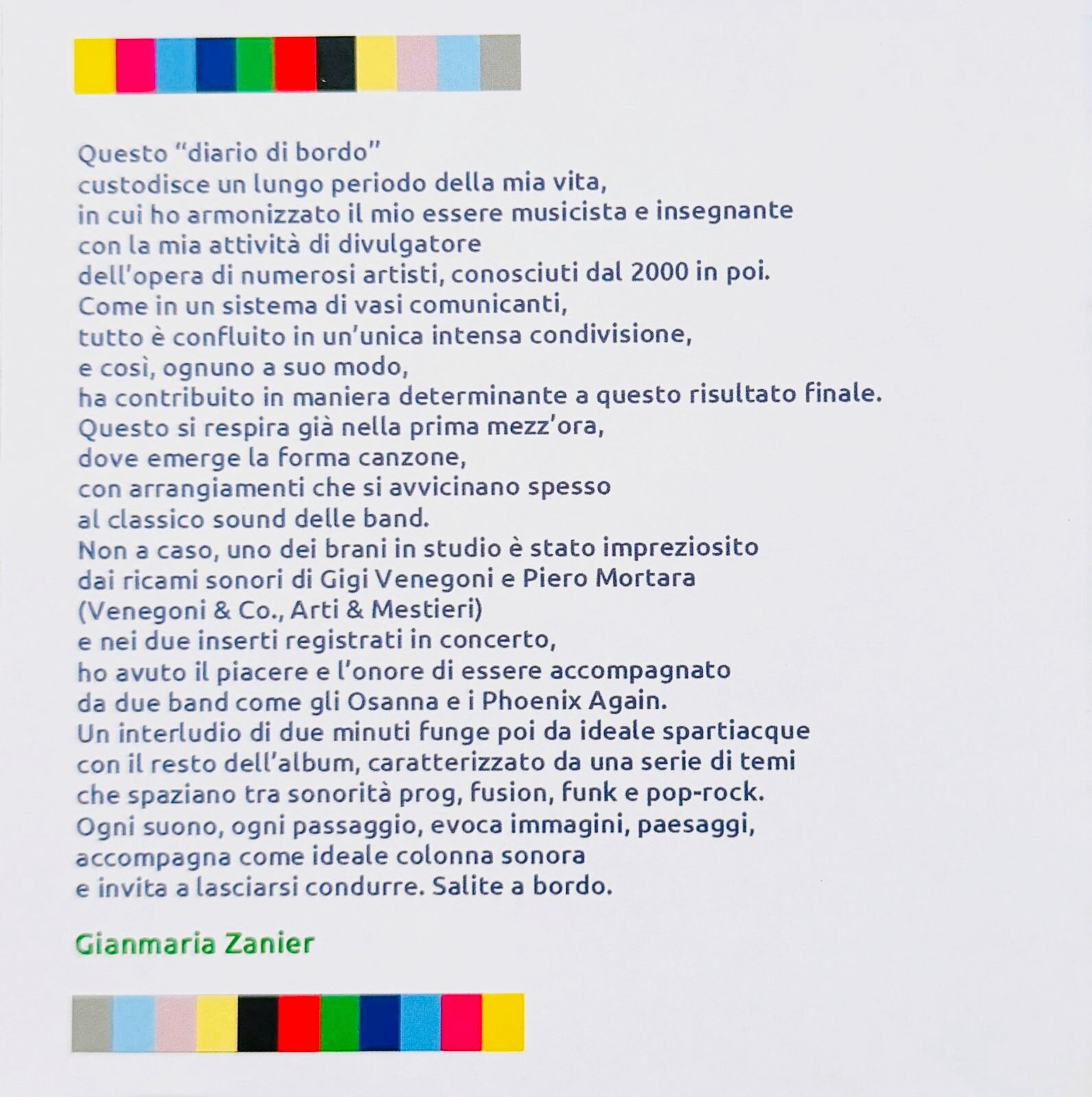
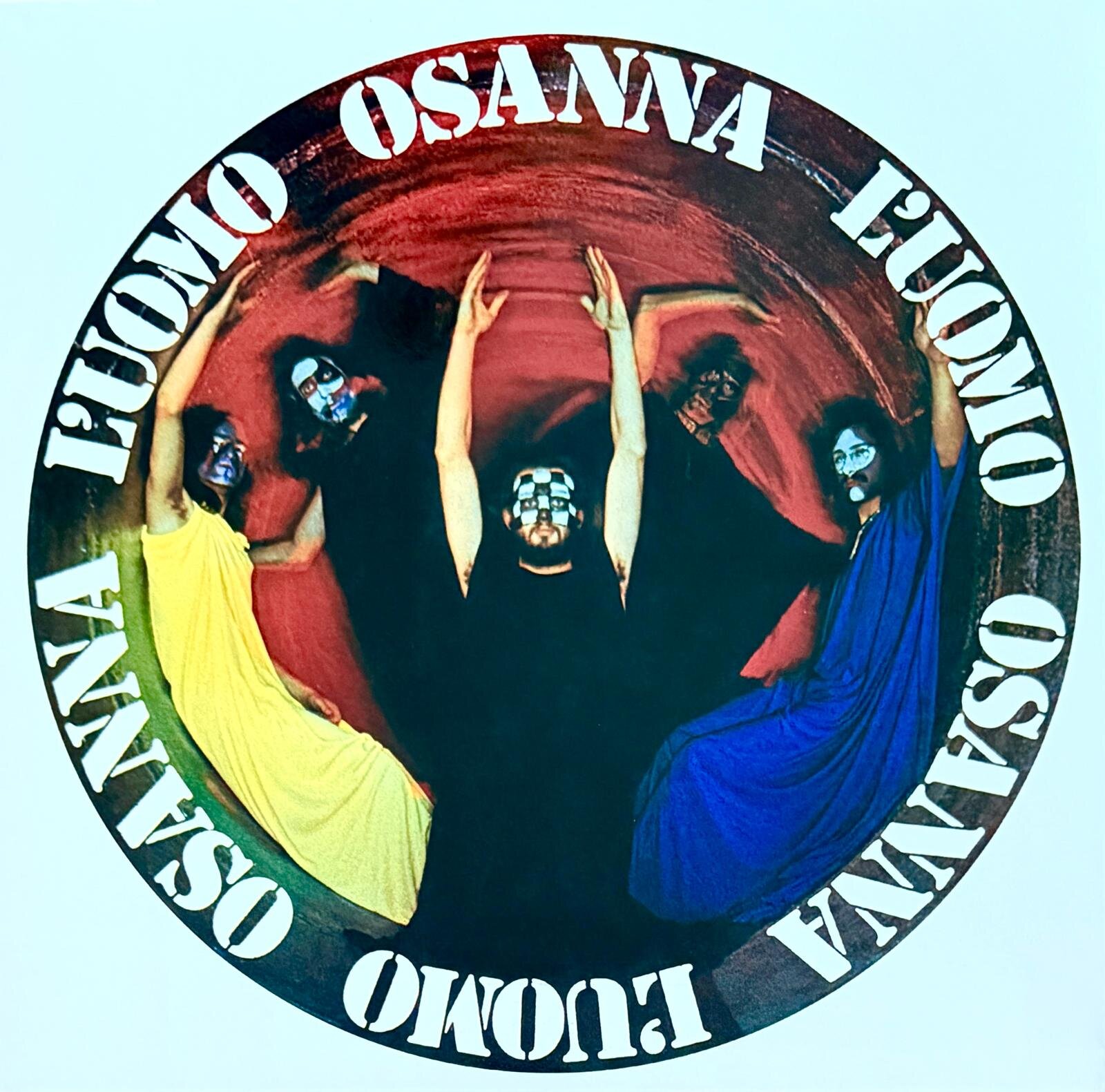
It's no coincidence that one of the studio tracks was embellished with the sonic flourishes of Gigi Venegoni and Piero Mortara (Venegoni & Co., Arti & Mestieri), and in the two inserts recorded in concert, I had the pleasure and honor of being accompanied by two bands: Osanna and Phoenix Again. A two-minute interlude then serves as an ideal watershed with the rest of the album, characterized by a series of themes that range from prog, fusion, funk, and pop-rock sounds. Every sound, every passage evokes images, landscapes, accompanies like an ideal soundtrack and invites you to let yourself be carried away. Come aboard!" Gianmaria Zanier
The dedication, which I'd like to quote in full, to his father, Adriano Zanier, is beautiful. He also quoted it among the first words of a brief conversation I had the pleasure of having with him, which makes me think of the profound importance he played in his life, along with his mother, Maristella:
"The entire album is dedicated to the memory of my father, ADRIANO, and to the tremendous tenacity and strength of character with which my mother, MARISTELLA, has faced and continues to face life, especially since 2003, always supporting me in all my decisions and circumstances."
Gianmaria's father, Adriano Zanier (May 22, 1948 – June 26, 2003), was a professional Italian footballer and later coach, known for his goalkeeping career and having played for several teams.
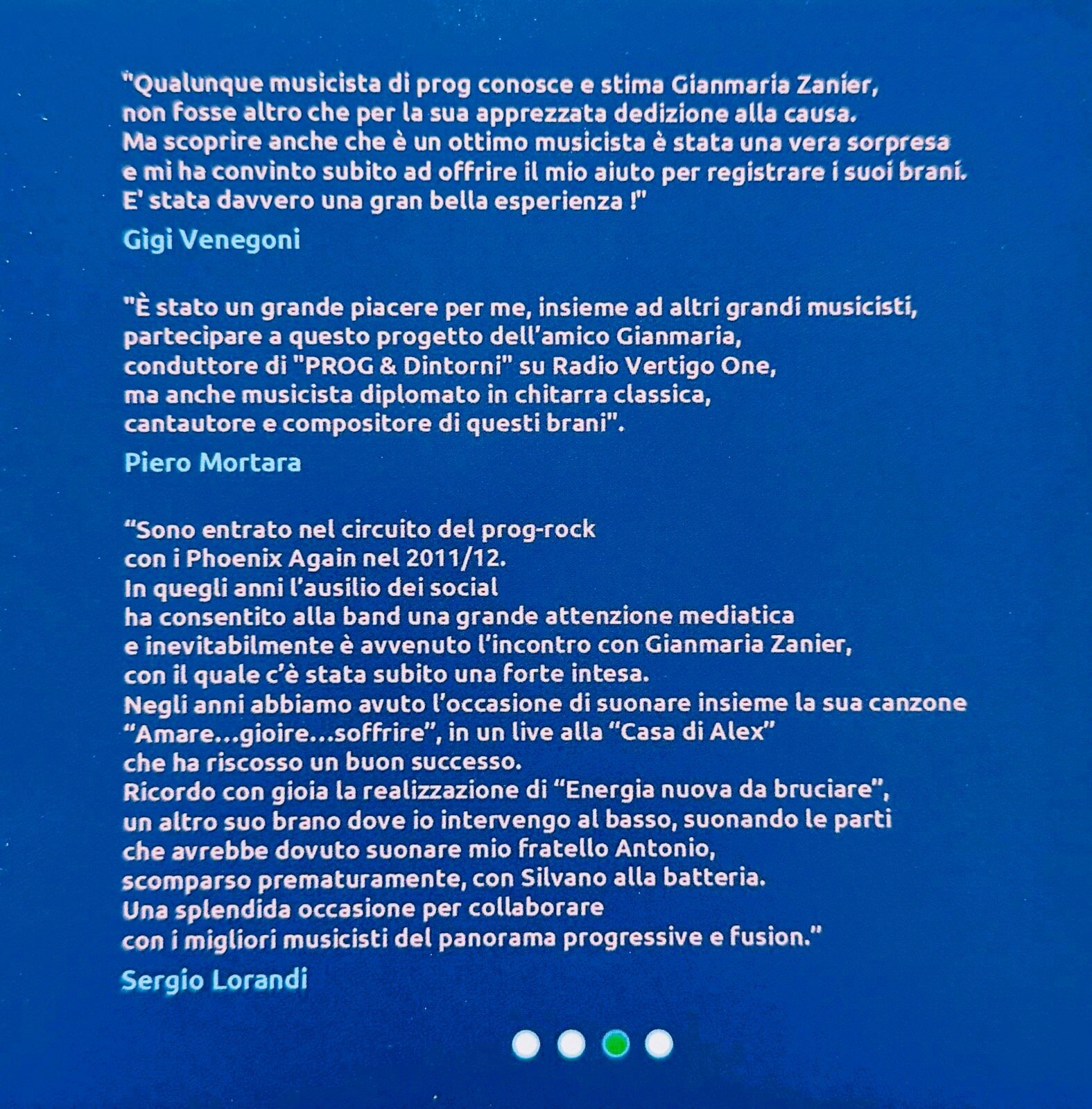
The studio version of "Energia nuova da brucia" features a touching dedication: "...dedicated to the memory of ANTONIO LORANDI of Phoenix Again. He was supposed to play the bass parts on the song, but unfortunately he didn't make it in time." Antonio Lorandi was the founding bassist and a key member of Phoenix Again, who sadly passed away on July 12, 2024. Together with his brothers Claudio (lead guitar) and Sergio (guitar), and drummer Silvano Silva, he founded the band "Phoenix" in October 1981. His passion for music began early, initially influenced by classical music and later by rock. Listening to Jimi Hendrix, Led Zeppelin, and progressive albums such as Genesis' Nursery Crime and Pink Floyd's Meddle shaped his style and preference for the progressive rock genre. After the untimely death of his brother Claudio in 2007, the remaining members reunited, adding "Again" to the band's name to symbolize rebirth and to release decades of previously unreleased original music. Antonio was highly regarded not only for his musical talent but also for his personality. Colleagues and friends described him as "a gentle soul, a great musician, a true friend." He was known for always being present at musical events, supporting the prog scene even when he wasn't playing with his band.
The Lineup
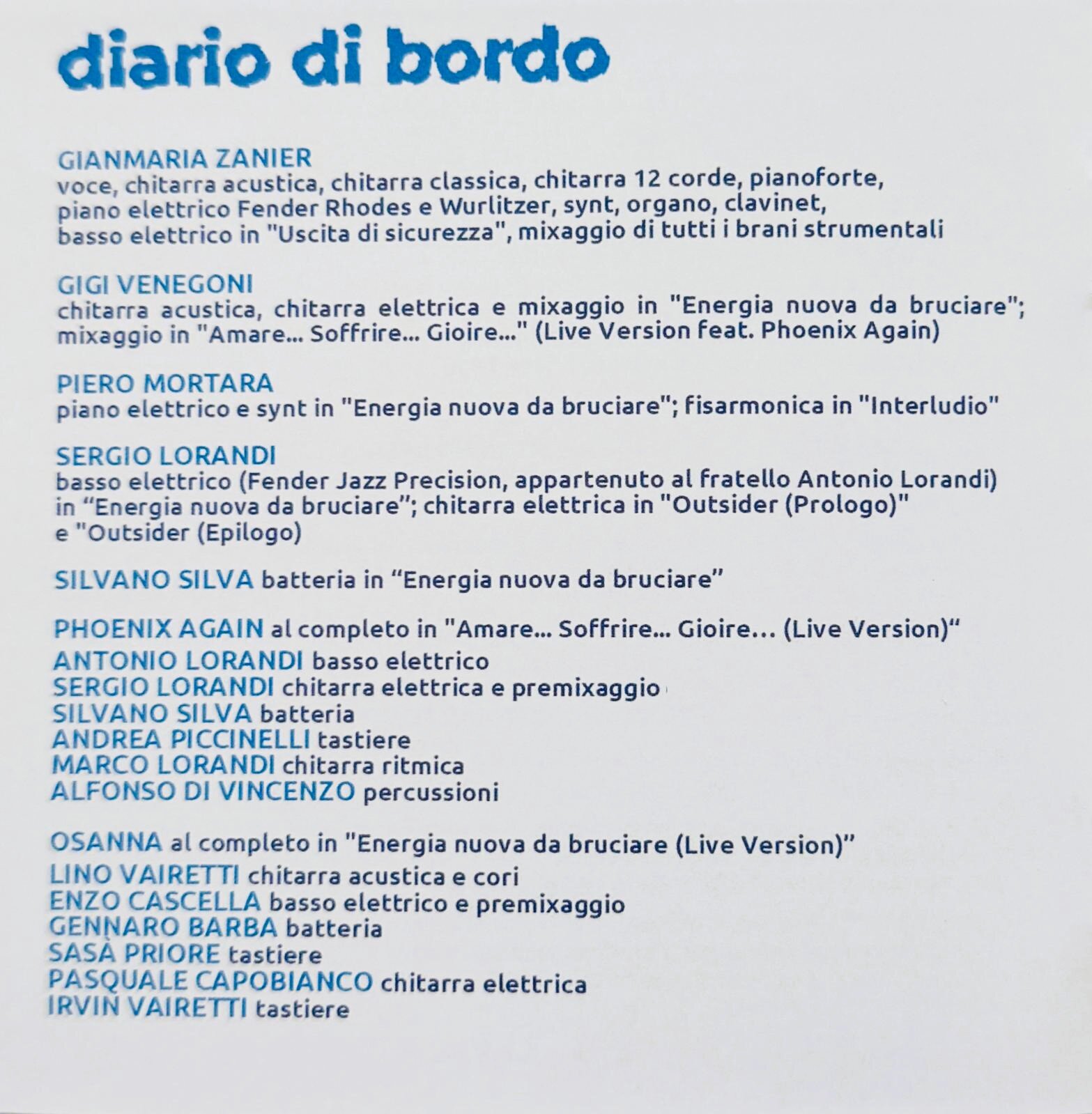
Gianmaria Zanier is on vocals, acoustic guitar, classical guitar, 12-string guitar, electric guitar, piano, Fender Rhodes and Wurlitzer electric piano, synthesizer, organ, clavinet, and electric bass on "Uscita di sicurezza." He mixed all the instrumental tracks, and the album features illustrious guests from the Italian progressive rock scene, including members of Osanna, Phoenix Again, Arti+Mestieri, and Venegoni & Co., here they are in detail:
- GIGI VENEGONI of ARTI & MESTIERI: acoustic guitar, electric guitar, and mixing on "Energia nuova da brucia"; mixing on "Amare... Soffrire... Gioire..." (Live Version feat. Phoenix Again)
- PIERO MORTARA of ARTI & MESTIERI: electric piano and synthesizer on "Energia nuova da brucia"; accordion on "Interludio"
- SERGIO LORANDI of PHOENIX AGAIN: electric bass (Fender Jazz Precision, formerly owned by his brother Antonio Lorandi)
on "Energia nuova da brucia"; Electric guitar on "Outsider (Prologue)" and "Outsider (Epilogue)"
- SILVANO SILVA of PHOENIX AGAIN: drums on "New Energy to Burn"
PHOENIX AGAIN as a whole on "Love... Suffer... Joy... (Live Version)"
- ANTONIO LORANDI: electric bass
- SERGIO LORANDI: electric guitar and pre-mixing
- SILVANO SILVA: drums
- ANDREA PICCINELLI: keyboards
- MARCO LORANDI: rhythm guitar
- ALFONSO DI VINCENZO: percussion
OSANNA as a whole on "New Energy to Burn (Live Version)"
- LINO VAIRETTI: acoustic guitar and backing vocals
- ENZO CASCELLA: electric bass and pre-mixing
- GENNARO BARBA: drums
- SASA PRIORE: keyboards
- PASQUALE CAPOBIANCO: electric guitar
- IRVIN VAIRETTI: keyboards
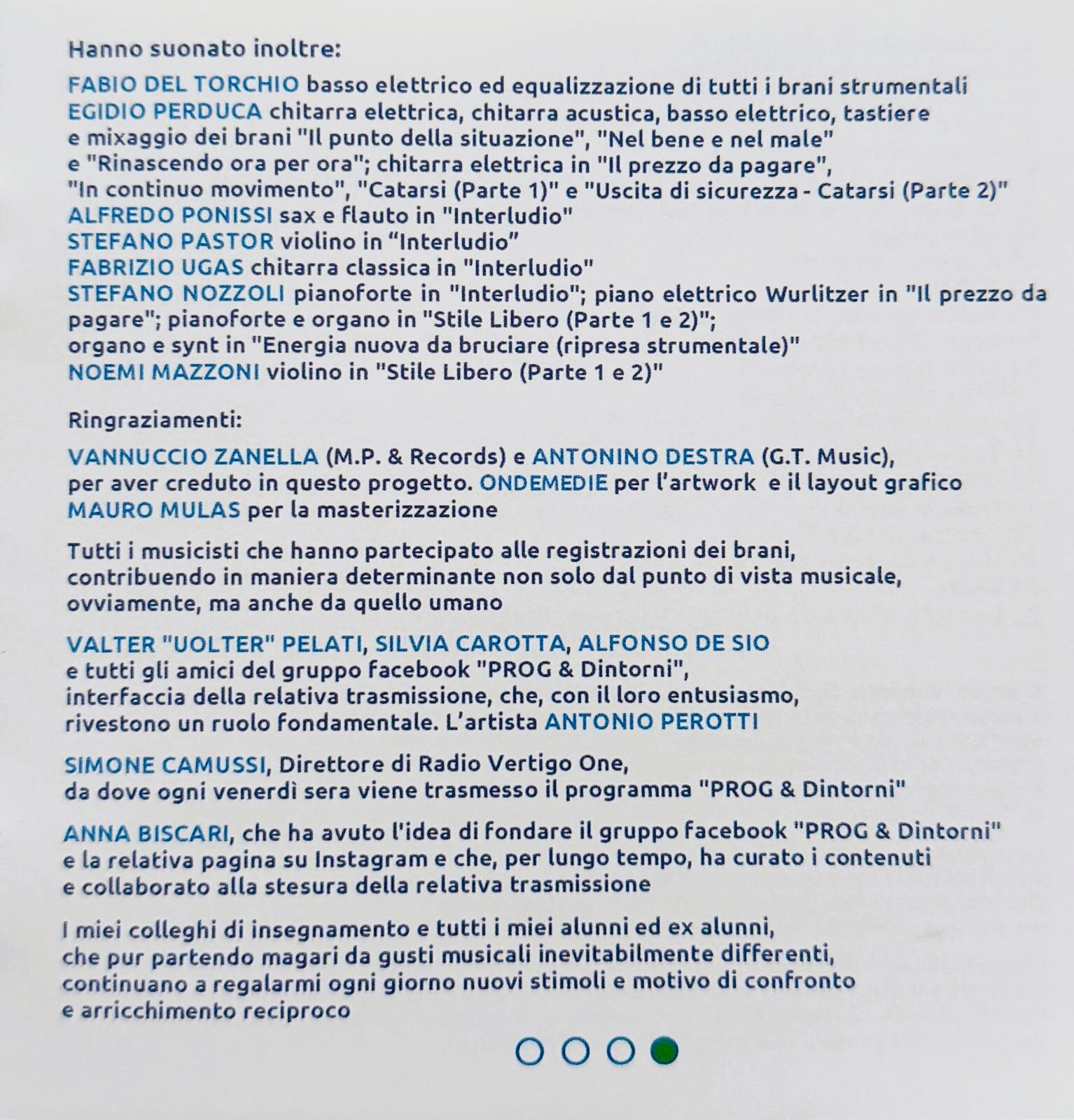
Also performing:
FABIO DEL TORCHIO: electric bass and equalization for all songs Instrumental
EGIDIO PERDUCA: electric guitar, acoustic guitar, electric bass, keyboards, and mixing of the songs "Il punto della situazione," "Nel bene e nel male," and "Rinascendo ora per ora"; electric guitar on "Il prezzo da pagare," "'In continuo movimento," "Catarsi (Parte 1)," and "Uscita di sicurezza - Catarsi (Parte 2)"
ALFREDO PONISSI: saxophone and flute on "Interludio"
STEFANO PASTOR: violin on "Interludio"
FABRIZIO UGAS: classical guitar on "Interludio"
STEFANO NOZZOLI: piano on "Interludio"; Wurlitzer electric piano on "Il prezzo da paga"; piano and organ on "Stile Libero (Part 1 and 2)"; organ and synthesizer on "Energia nuova da brucia (instrumental reprise)"
NOEMI MAZZONI: violin on "Stile Libero (Part 1 and 2)"
Important contributions cited in the acknowledgements:
VANNUCCIO ZANELLA (M.P. & Records) and ANTONINO DESTRA (G.T. Music), for believing in this project. ONDEMEDIE for the artwork and graphic layout
MAURO MULAS for mastering
Gianmaria also points out in the liner notes that all the musicians not only participated in the recording of the songs but also contributed significantly not only from a musical point of view, obviously, but also from a human one.
VALTER "UOLTER" PELATI, SILVIA CAROTTA, ALFONSO DE SIO, and all the friends of the "PROG & Dintorni" Facebook group, the interface for the program, who, with their enthusiasm, play a fundamental role.
The artist ANTONIO PEROTTI; SIMONE CAMUSSI, Director of Radio Vertigo One, where the "PROG & Dintorni" program is broadcast every Friday evening; ANNA BISCARI, who had the idea of founding The Facebook group "PROG & Dintorni" and its Instagram page, which for a long time curated the content and collaborated on the production of the related program.
Thanks are also due to my teaching colleagues and to my students and alumni, "...who, despite perhaps starting with inevitably different musical tastes, continue to provide me with new inspiration and opportunities for mutual exchange and enrichment every day."
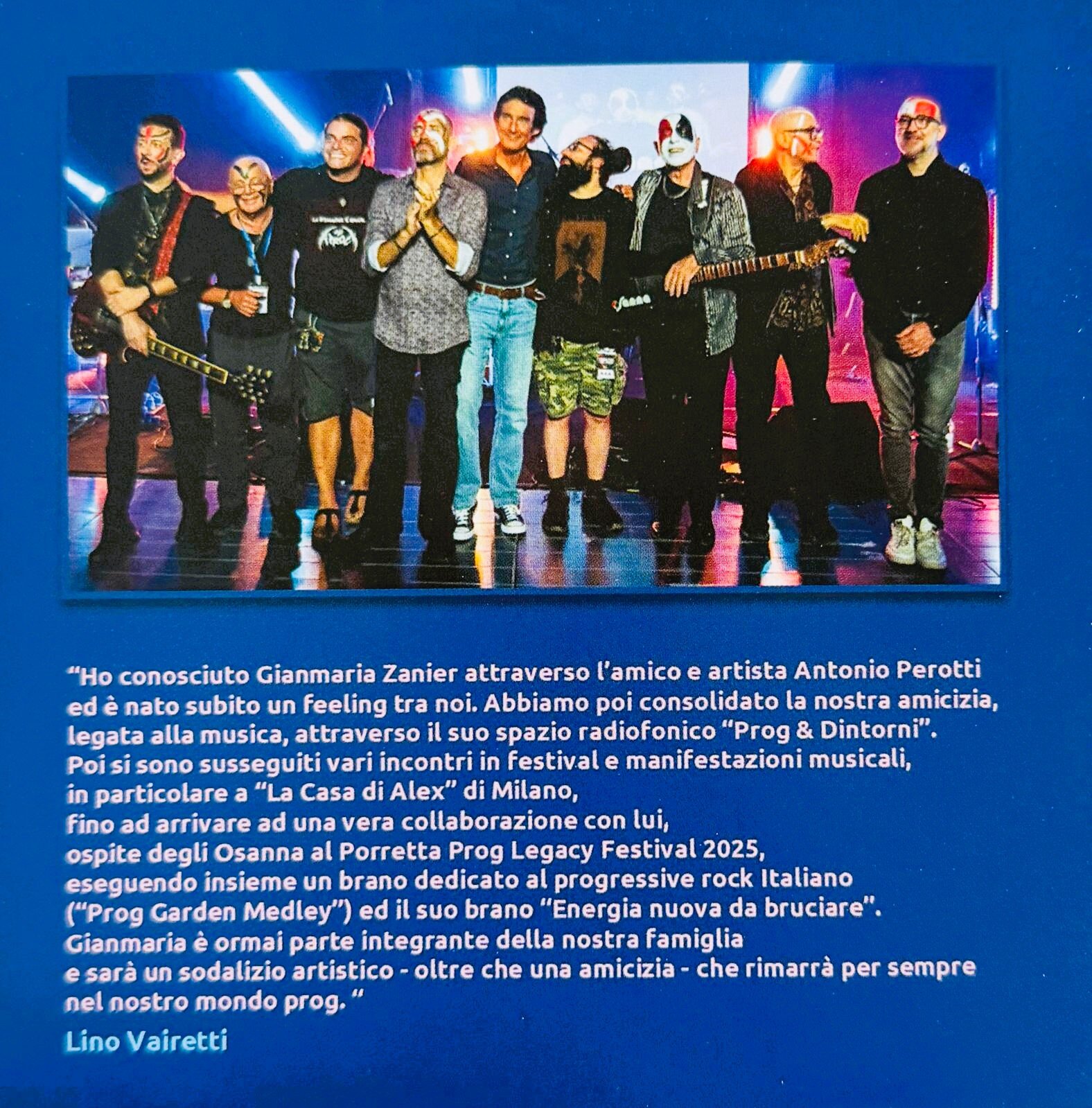
The words of Lino Vairetti, Gigi Venegoni, Piero Mortara, and Sergio Lorandi are very kind, and can be found in the liner notes and in the photos at the end of the article.
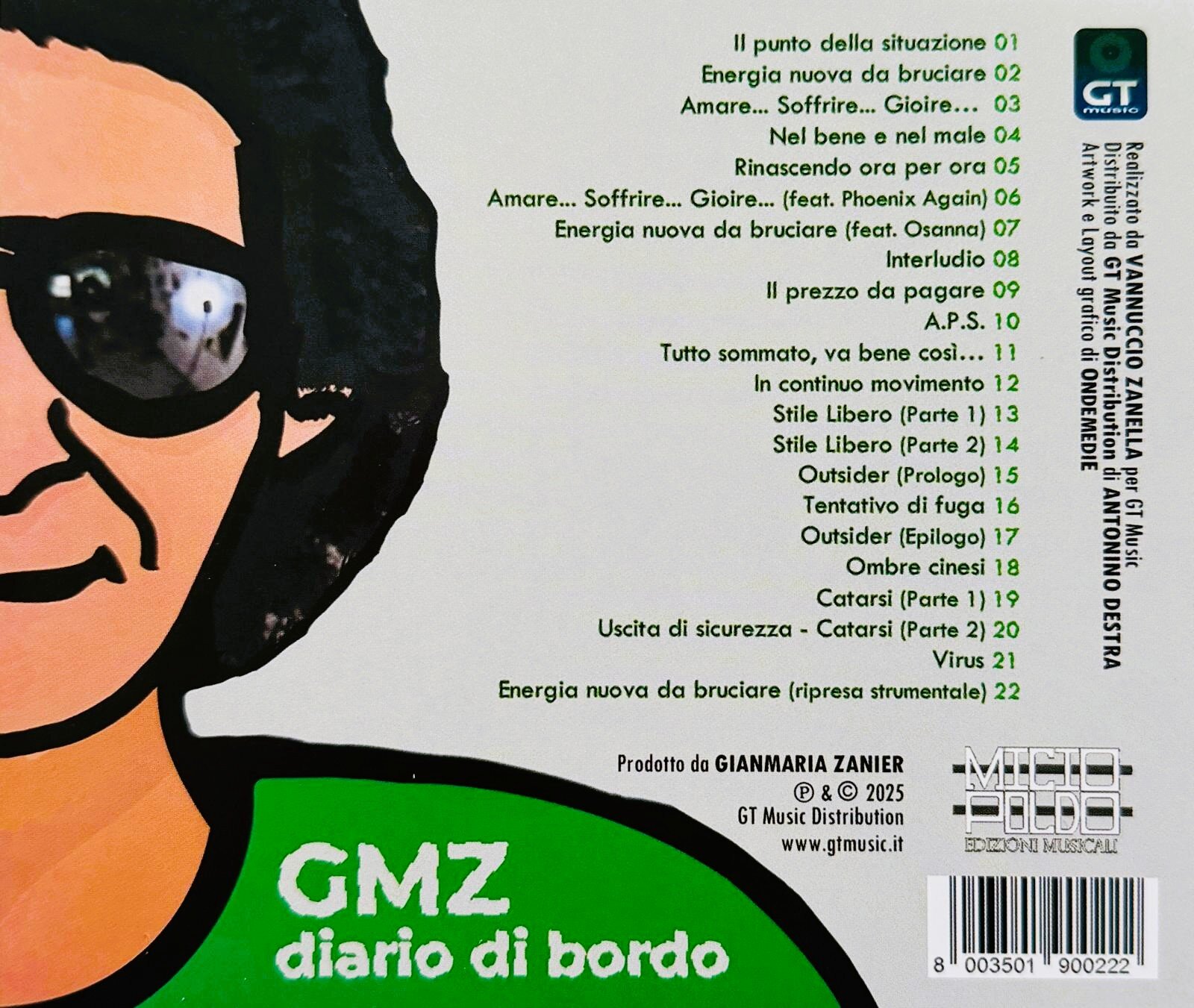
The Tracks:
Il punto della situazione (The current state of affairs). The album opens with what appears to be a conceptual manifesto, a lucid and bitter reflection on the condition of the artist in contemporary society, which questions the listener ("Tell me, what is it?") to highlight a cultural system now devoid of substance. The critique of appearance and the "Grand Guignol" is a cultured reference to the Parisian theater, known for its macabre and theatrical performances, a metaphor for a grotesque, excessive daily reality, in which people are forced to act and therefore behave like a "jester who never smiles for himself," representing the artist who must entertain others, losing his own authenticity and inner happiness.
I've found the same themes, treated in different styles, in numerous prog albums. I'd like to mention a couple I love: Peter Hammill's "The Silent Corner and the Empty Stage," a profound reflection on the life of a musician, who must constantly negotiate between authentic artistic expression (the silent corner) and the pressure of success and an audience (the stage), and Jethro Tull's "Minstrel in the Gallery," a concept album that revolves around the metaphorical figure of the "minstrel," representing the modern artist, described as an observer almost detached from the facts, who positions himself in a position of observation, elevated above them.
Despite this realistic and unenthusiastic view of reality, a strong will to resist ("I will not give up") emerges, which also signifies hope. The image of the "deafening silence of confusion" is beautiful, an oxymoron that effectively describes the constant background noise of the media, which communicates nothing meaningful.
The reference to "The 400 Blows" is also very beautiful, a reference to François Truffaut's cinematic masterpiece (Les Quatre Cents Coups). In French slang, "to raise hell," to rebel, to live intensely, overcoming limits. Here, it's used to represent an intellectual rebellion, to "emerge from the hubbub," to stand out from the noise of the crowd, to decide "my own way"... "AT LEAST ME!": in a world drowning in conformity, the artist asserts the right to remain true to himself.
A cultured and theatrical piece, which from the opening is a declaration of intellectual honesty without "presumption" or "arrogance," knowing it's going against the grain and without the expectation of easy approval.
Musically, it's a song that belongs to the world of Italian prog, both in its musicality and its atmosphere, a melodic prog with an emphasis and use of keyboards that conveys a sunny and positive mood, along with sensations of spaciousness. Along with a linear tempo, the keyboards and vocals bring a Mediterranean prog feel. The guitar solo and keyboards are beautiful. The rhythm section is extremely precise.
Energia nuova da bruciare (New Energy to Burn) is a reflection on the state of mind of dissatisfaction and the search for radical change in life, described through the desire for an internal "combustion," a catalytic event that can provide the necessary impetus to break out of routine and oppressive "normality."
There is dissatisfaction and a search for meaning in relationships ("that woman"), at work ("a job, but which one, if there isn't one?"), or in physical places ("that house," "nightclub"), but without success.
There is the central metaphor of "new energy to burn," a visceral need for a jolt, an experience that allows one to "restart," "design" a new dimension, or "play a new role."
There's nostalgia for the passing of time ("I feel like every moment is slipping away from me"), a sense of precariousness, and the fear of wasting life, which translates into "clouds of nostalgia" for what hasn't been or isn't yet.
"Normality" can be a refuge or a condemnation, with the awareness of remaining "normal" in a society made up of "hypocrisies," "slightly bitter realities," "little illusions," and "bitter laughter," a safe haven and the renunciation of one's greatest aspirations.
An honest and introspective depiction of reaching an existential crossroads, between the search for vital energy and the acceptance of a state of "normality."
High-quality pop tinged with the typical atmosphere of Italian melodic prog, especially in the keyboards. The backing vocals are beautiful, and the overall atmosphere is reminiscent of high-quality Italian singer-songwriters. The mood is sunny and positive. Here too, the electric guitar solo and supporting rhythm guitars are excellent.
Amare... Soffrire... Gioire... (Loving... Suffering... Joying…) is a song about resilience, accepting life's complexities, and the determination to continue on despite past disappointments. It's a hymn to perseverance, recognizing that life is a continuous cycle of conflicting emotions, but that it's worth living with energy. Between "small disappointments" and "a handful of illusions," the need to not deny the past, but to move past it without forgetting it, cherishing it ("But if I've understood it now, could it even be a timid sign?") is evident.
Many conflicting emotions: "Loving, suffering, rejoicing... and then starting again... talking... letting off steam... and then starting again... getting angry...", along with the personal growth that comes from accepting this cycle.
The heart of the song is the final decision: "I will resist!" An active response because resistance isn't about suffering, but about persevering with energy.
An invitation to look life in the face, with its joys and sorrows, and to consciously choose to "resist" and continue the journey, finding strength in one's humanity and the constant search for personal fulfillment.
Musically, the song begins with a beautiful intro featuring rhythm guitar and an almost funk-like tempo. It's a very enjoyable, upbeat piece with a catchy chorus that sticks in your head. The keyboard and guitar work are beautiful. The bass part is great. The song contains a jam-like section that repeats several times with an almost jazzy feel. The keyboard solo is beautiful.
Nel bene e nel male (For better and worse), it's an unwavering declaration of love that alternates between moments of remembering initial hope ("I hoped to make you fall in love") and moments of acknowledging rejection ("YOU DIDN'T BELIEVE IN ME!"). But despite the realism of the situation, hope is not lacking; the idea of the loved one still allows him to "dream" and travel, even just in thought.
Long journeys ("500 kilometers in 4 hours") metaphorically become "fast lanes," a "personal toll booth" that will allow the other person to access (again) the feelings they've already felt.
An ode to love that resists time, distance, and even rejection, offering both a safe haven and a "fast lane" in the author's heart.
A rhythmic song that harks back to the 1970s golden age of Italian melodic rock. The lyrics are supported by an energetic tempo and a captivating mood. The composition is beautiful. The keyboards are beautiful in a song with a simple structure yet great intensity. The solo with overlapping guitars is also beautiful here.
Rinascendo ora per ora (Reborn hour by hour) is the culmination of a journey of awareness and resilience. While doubt or anticipation prevailed in other songs, here the central theme is ongoing metamorphosis and the active desire to reclaim one's existence.
The song opens with a powerful image: "Rinato dalle mie rovine" (Reborn from My Ruins): the past is not denied, but used as a foundation for reconstruction, an escape from the "golden prison" that impeded growth with the "strength to start over" and the "desire to change." A gaze on reality that perceives its nuances, the indecipherable and contradictory, yet light; the immediate, yet distant; the banal and decadent, yet so alive.
A world that "in everyday life always seeks the virtual without being real anymore" and that must be approached by being "Other" while remaining "Self," changing without betraying its essence, "Dying, but reborn hour by hour."
A manifesto of realistic optimism, one that doesn't ignore the difficulties of the modern world or the past, but chooses life, action, and continuous transformation.
A thought that has fascinated me for decades and that arose in my personal experience from reflections on the famous aphorism attributed to the Greek philosopher Socrates, "He who wants to move the world, must first move himself." Global change must begin with personal transformation, self-improvement, and individual awareness, necessary to positively influence the outside world through action and self-knowledge.
The keyboard intro and melody in this sunny and expansive piece are beautiful, with a simple structure that evokes positive emotions. Piano and keyboards are prominent on a simple rhythmic basis that supports the song's positive atmosphere. Once again, the vocals and guitar solo are beautiful, with a nice sustain.
The live version of "Amare... Soffrire... Gioire..." (Live Version - feat. Phoenix Again) respects the structure and duration of the studio version but features a great choral performance from the entire band, with the great Phoenix Again emphasizing the song with beautiful guitar and vocal phrasing and a splendid keyboard performance, the instrumental sections in a truly excellent jam-like finale.
The song "Amare... Soffrire... Gioire..." (Live Version - feat. Phoenix Again) was recorded during Phoenix Again's concert at "Casa di Alex" in Milan on March 30, 2019.
The live version of "Energia nuova da brucia" (Live Version - feat. Osanna), like the previous song, respects the original structure and duration of the studio version. This time, the legendary Osanna enriches the song with excellent performances. The live intensity of the song and the density of the sounds are beautiful. The guitar solo is beautiful.
The song "Energia nuova da brucia" (Live Version - feat. Osanna) was recorded during Osanna's concert at the "Porretta Prog Legacy" in Porretta Terme on July 11, 2025.
Both live versions of the songs suffer from the poor quality of the live recording, which, however, does not diminish their impact on the listener.
Interludio, as Gianmaria himself points out, is a delightful orchestral interlude that separates the two ideal halves of the album: the first with a songlike structure and the second more instrumental. A beautiful composition for an instrumental with accordion, wind instruments, strings, and piano.
Il prezzo da pagamento (The Price to Pay) is a song that begins with a serene yet interlocutory mood, with a progression reminiscent of Canterbury sounds, but with a melodic foundation typical of Italian prog. The execution and atmosphere provided by the keyboards and the light, nuanced drums are splendid. The song alternates between more dynamic and more ethereal moments, with beautiful bass and guitar parts over a carpet of keyboards.
A.P.S. is a song with a captivating rhythm and a splendid bass part. The mood is positive and sunny, with keyboards alternating with light layers and a beautiful electric piano. The melody is fresh, and the piano inlays create a feeling of great emotional transport.
Tutto sommato, va bene così... (All in all, it's fine…) it begins with electric piano and keyboards in a beautiful melody, followed by acoustic guitar, piano, and keyboards, and unfolds in a serene and light atmosphere throughout. The melody is beautiful and perfectly captures the concept behind the title.
In continuo movimento (In constant motion) is a jazzy piece in its initial atmospheres, with tempo changes supported by a dynamic and virtuoso rhythm section and a beautiful interplay between guitar and keyboards. It also features moments that veer towards eclectic prog and classical, with epic passages and beautiful percussion that at times hark back to the world of Santana, and keyboards with sounds, atmospheres, and loops that are at times spacey. The guitar is in great shape, but the entire song highlights each of the musicians. The electric piano and the underlying melody are beautiful. A constantly moving piece.
Stile Libero (Part 1) (Freestyle (Part 1)) begins with a beautiful guitar and piano riff that evokes an eerie atmosphere, that of a carousel or a dark music box, and then launches into a beautiful guitar riff, a bold rock sound, and a beautiful keyboard riff. The rhythm is slow and insistent before shifting to a softer jazz mood with excellent virtuosity until the second part, Stile Libero (Part 2) (Freestyle (Part 2)), which begins lightly, reprising the same basic theme with strings taking center stage, supported by an orchestral guitar and keyboards, and a nuanced rhythm section. The bass and the dialogue between guitar and keyboards are also beautiful here. The piece lights up at times with a more assertive rock sound as the piece becomes more energetic and at times epic.
Outsider (Prologo) (Outsider (Prologue)) is a short instrumental piece that begins a mini-suite composed of three pieces that develop the same theme with different emphases, with an epic atmosphere and extensive guitar and piano parts. The pace becomes pressing, supported by a beautiful electric piano melody and a carpet of keyboards before fading away. Tentativo di fuga (Tentative of Escape) follows, reprising the same theme as the previous song, and the same occurs with Outsider (Epilogo) (Outsider (Epilogue)), in which the same theme is reprised with a more epic and imposing opening pace, leaving room for the excellent work of guitar, piano, and keyboards. The entire suite is based on a very effective original melody that is reminiscent in style and impact of Goblin's most famous songs.
Ombre Cinesi (Chinese Shadows) is a melodic piece with a beautiful opening guitar arpeggio and a ballad-like pace, creating a light, positive atmosphere and a constant feeling of serenity. The melody is beautiful, and the keyboard and guitar work is excellent throughout.
Catarsi (Parte 1) (Catharsis (Part 1)) is the first part of one of the album's standout tracks, an important piece with an epic opening reminiscent of old-time Italian prog. The melody is excellent once again, with beautiful harmonies between the various instruments. The drums and bass are excellent, and the guitar and piano parts are beautiful. Uscita di sicurezza - Catarsi (Parte 2) (Exit of Safety - Catharsis (Part 2)) follows the themes of the first part, but with a variation that makes the song more epic and imposing in the middle. The guitars and the incisive and powerful rhythm section continue to perform flawlessly. The song closes with the acoustic guitar that opened it.
Virus begins with a haunting, almost cinematic piano riff; it could be the soundtrack for a fast-paced thriller, and here Gianmaria's passion for film scores, as mentioned at the beginning, shines through. The atmosphere is beautiful, and the bass in the middle is beautiful, both melodic and rhythmic. The keyboards, with their excellent sound and syncopated interludes, fuel the tension.
Talking about it with Gianmaria, he explains to me that… The “virus”, in a good sense, is that of progressive rock and its surroundings, which “infected” him since his early years as a musician, but it is clear that in this case there are references to many other things: first and foremost with regards to various soundtracks, but not only…
The instrumental reprise of "Energia nuova da bruciare" is more rhythmic than the sung version and has a different energy, enriched by intricate guitar work. Compelling, an excellent conclusion to the album.
I had the opportunity and privilege of meeting Gianmaria "virtually" in brief offline conversations where I asked about the album and his personal story. What immediately emerged was the profile of a passionate and kind person, not at all self-referential and highly sensitive, who often speaks of feelings without explicitly naming them, but which often shine through in his stories, in his vocal inflections, and after careful listening to the album, in the lyrics and melodies.
This album represents the current state of a long personal and artistic journey. I hope, however, that it's just a page in a travel diary: I've found many ideas, both in the lyrics and the compositions, that deserve to be further developed in a new work. Great work, Gianmaria!!!
Note: All links to the musicians' works are in the TAGS under the article title or on the "Artists" page.