
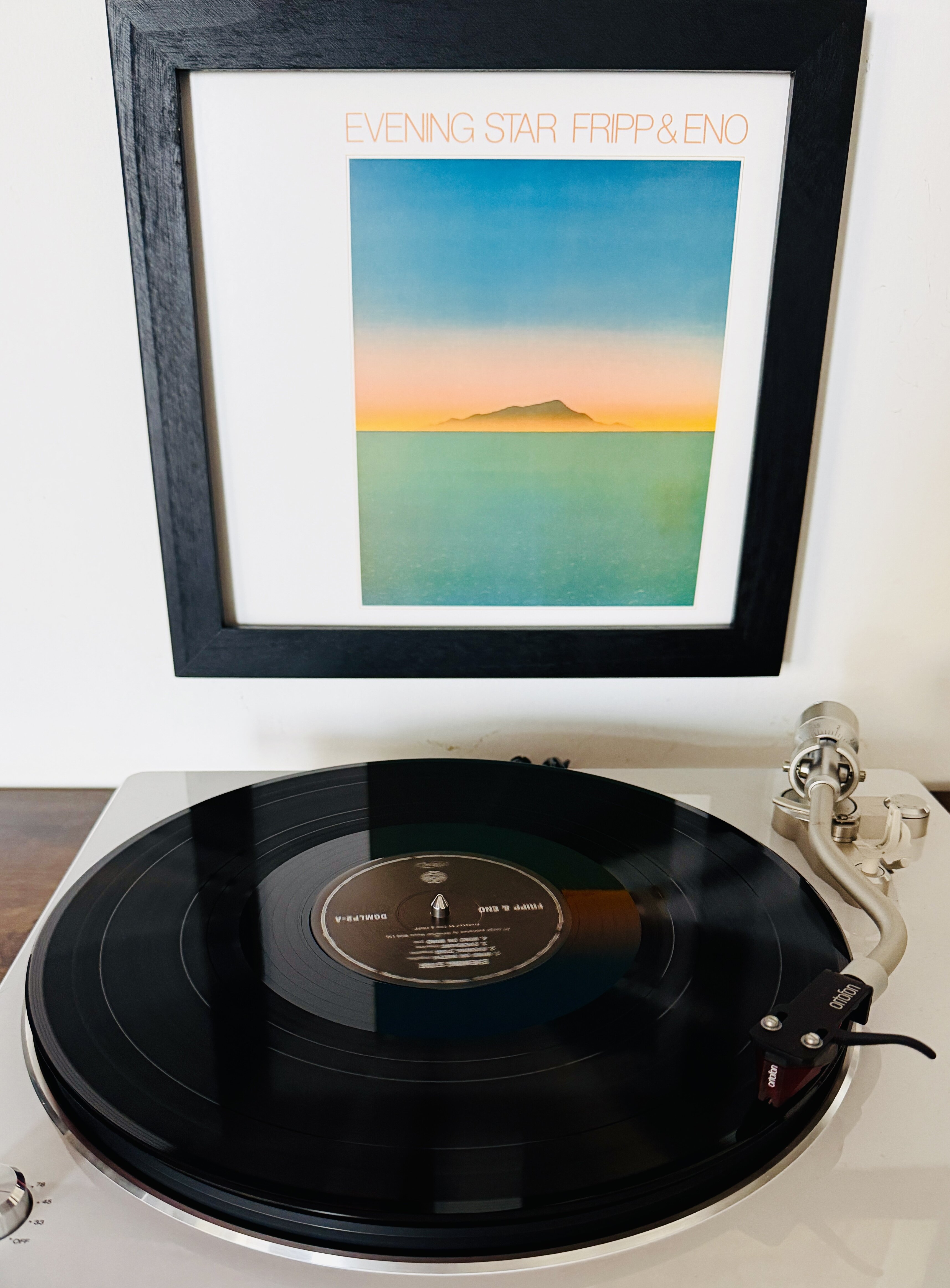
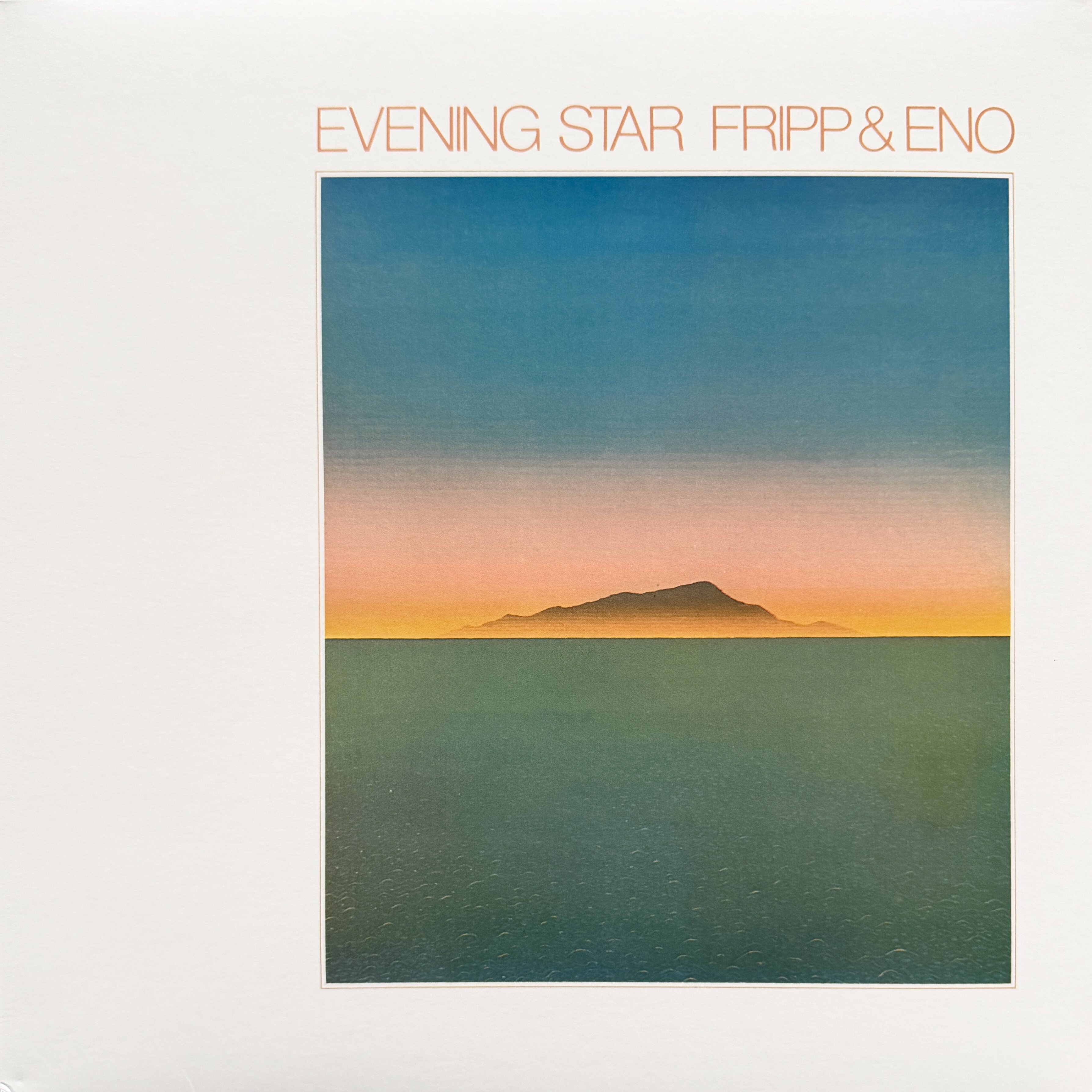
Evening Star by Fripp & Eno, a 1975 album.
On Progressive Rock World, Robert Fripp and Brian Eno have been repeatedly celebrated as innovators, pivotal figures in experimental musical evolution.
On this site, their first appearance together in Matching Mole's 1972 "Little Red Record", a project by Robert Wyatt and produced by Robert Fripp in which Brian Eno is seen as a guest on synthesizers, a fundamental meeting point before their official collaborations as a duo.
Both Robert Fripp and Brian Eno appear in the sections dedicated to biographies and essential discographies.
I celebrated Fripp not only for King Crimson but also for his innovative solo drive and I consider him the very embodiment of the paradigm of the progressive musician, the one who redefined the concept of the rock guitarist with his unique guitar style capable of re-inventing progressive rock through exercises on repetitive scales. A detached intellectual, the antithesis of the visceral iconography of rock, known for often playing seated and icy on stage and who coined the expression "Prog is an attitude" according to which Progressive Rock is not a fixed musical style, but a mental attitude that pushes conceptual boundaries beyond the already known.
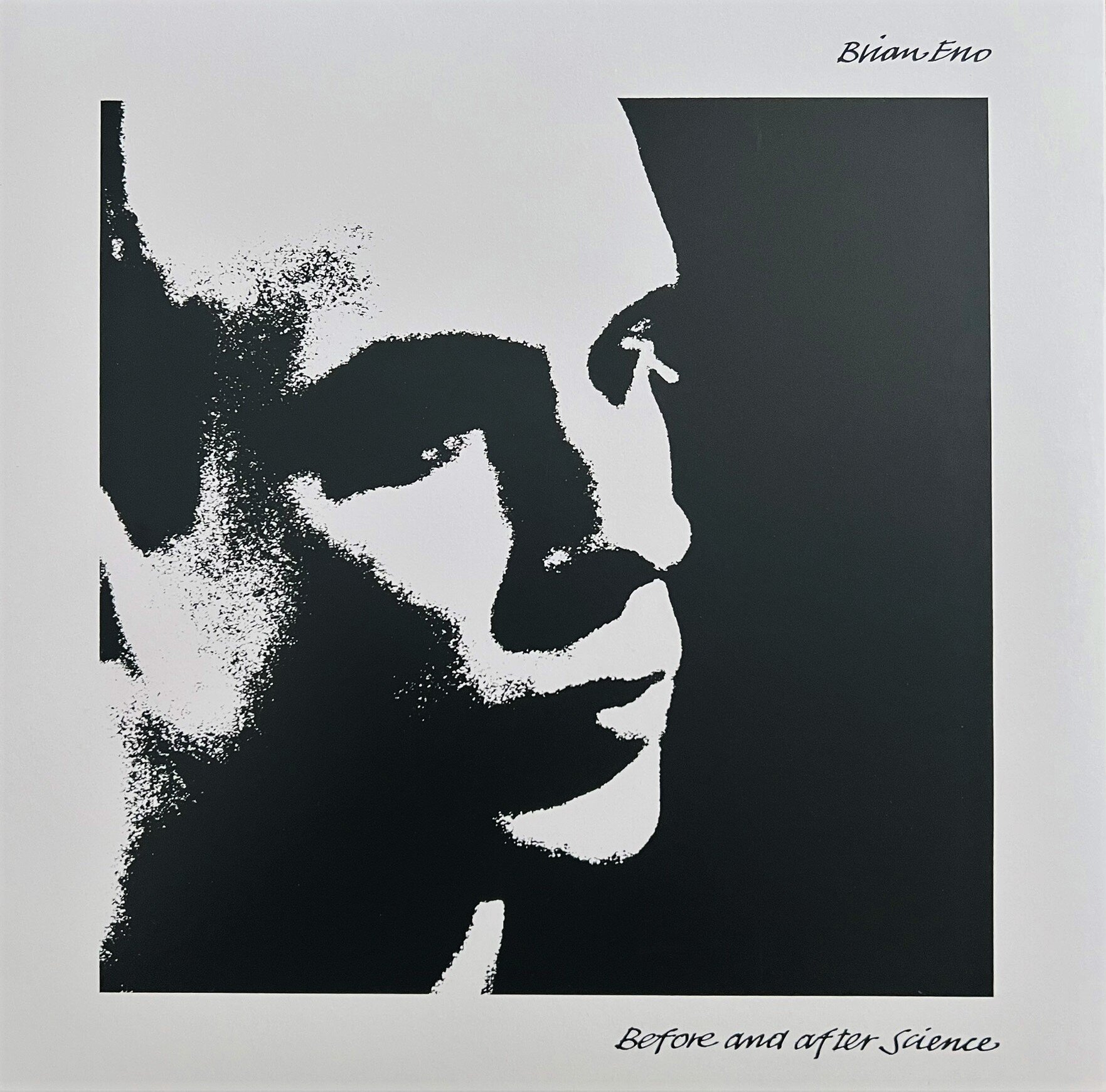
I have spoken at length about Brian Eno, a visionary, the "architect of sound", whose contribution is fundamental not only for electronics, but for the entire aesthetics of progressive and experimental rock, a point of reference for technological innovation applied to art and I reviewed "Before and After Science", a true masterpiece of 1977 but also albums of his important collaborations such as "Tracks and Traces" (Harmonia & Eno '76), an unexpected masterpiece, in which Eno's contribution on bass, synthesizer and lyrics is immense, or in "Mainstream" (Quiet Sun) with his electronic compositions that make each song sublime, differentiating himself from other records of the Canterbury scene for the unique style and finally with "The Lamb Lies Down on Broadway" (Genesis) with his crucial role in managing the effects ("Enossifications") for iconic songs such as "In the Cage".
Their individual careers and their collaboration are under the banner of Innovation and "Re-invention" and their great creative synergy in their works together has been oriented towards overcoming the mainstream rock of the 70s for a music "without labels".
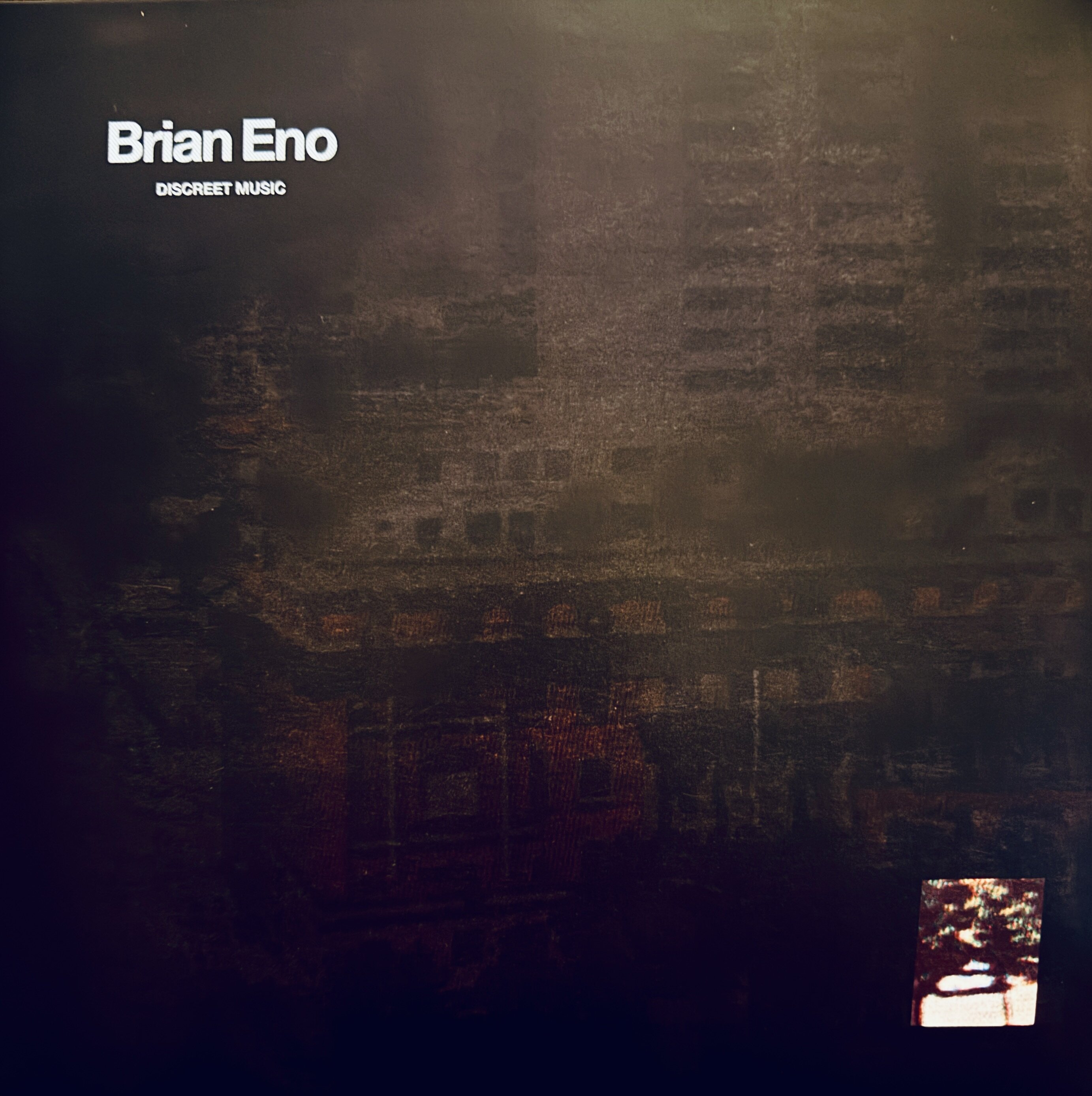
"Evening Star", released in December '75, is the second album that Robert Fripp and Brian Eno have made together. It is a fundamental record for ambient and experimental music, and has made the loop recording technique called Frippertronics famous. They recorded the album between '74 and '75, in a period of great changes for both. Fripp had just broken up King Crimson after "Red" and was going through a personal crisis that would lead him to take a break from music. Eno, formerly of Roxy Music, was instead defining ambient music, releasing the legendary "Discreet Music" at the same time.
The duo refined the tape-delay system introduced on their previous album (No Pussyfooting) in 1973, creating overlapping sound carpets on which Fripp improvised guitar solos.
Let's see how it works: The Frippertronics system is an analog loop technique that creatively exploits two reel-to-reel recorders (generally Revox A77 models) connected in an unconventional way. Rather than using each machine independently, the two recorders are placed next to each other and share the same magnetic tape:
Machine 1 (Recording): Holds the blank tape reel. Its recording head engraves the guitar signal on the tape.
Machine 2 (Playback): Receives the tape that comes out of the first machine. Its playhead reads the sound you just recorded.
The tape physically runs from the left reel of the first machine to the right reel of the second. The delay is not generated electronically, but is physical. The time that passes between recording and playback depends on two factors:
The further apart the two recorders are, the longer the loop (usually between 3 and 6 seconds).
A slower scrolling speed increases the length of the delay.
The fulcrum of the technique is the mixer that connects the two machines: The output signal from Machine 2 (the delayed one) is sent back to the input of Machine 1.
This creates a continuous loop, the old sound is re-recorded along with the new sound that Fripp is playing at that moment.
Since each step on the tape involves a minimal loss of quality and volume, the older loops gradually fade as the new ones emerge, creating an ever-changing sonic texture. Unlike modern digital pedals, Frippertronics offer a more natural experience: the tape introduces small imperfections (wow and flutter) and analog saturation that give the sound warmth and unpredictability. In addition, the entire process records the full performance on a master tape, capturing every single overlay in real time.
In the late 1990s, Fripp switched to Soundscapes, a digital version of this technique that uses complex signal processors to achieve even longer, layered loops.
"Evening Star" is an album that is at the crossroads between ambient music and electronic minimalism, and its strength lies precisely in the balance between these two apparently opposite souls. Compared to their first work, which was a bit of an experiment to understand how far the limits of technology could be pushed, this album is a deeper search for a balance between man and machine.
The key concept is that of "Ambient Music", an idea of Eno's from those years: music should be able to be listened to in different ways, depending on how much we want to concentrate. It can be the protagonist of the listening, or become a background that enriches the environment. The album does not want to impose a specific emotion on us, but to create a sound space in which we can feel free to inhabit.
Fripp and Eno were not looking for the perfection of sheet music writing, but wanted to create a process. The "concept" is the Frippertronics' setup: once the loop system is set, the musician loses some control. In this way, the album celebrates the unexpected: the way sounds overlap and transform on the tape is a collaboration between Fripp's human intent and the physics of Eno's machine and tape recorders.
The album is divided into two sides, each with a very specific identity:
In Side A we find the ethereal, the immaterial, the pastoral beauty. It is the "Evening Star" that shines in the sky. The atmospheres are meditative, ethereal and "pastoral". The title track is one of Fripp's most beautiful performances.
Side B represents weight, earth, industrial. It is a chemical and physical analysis of sound, which becomes heavy and dense like metal. The side is entirely occupied by the 28 minutes of "An Index of Metals". This song is the opposite of the first part: dark, dissonant and based on layered metal distortions.
Unlike the progressive rock of the time, which focused on the virtuosity and ego of the musician, here the concept is subtraction. Fripp puts his technique at the service of long notes and silences, while Eno works to "hollow" the sound rather than fill it. It is a real exercise in sonic humility.
Robert Fripp abandons aggressive distortions for a clean, fluid and almost flute- or synthesizer-like sound, thanks to prolonged use of the volume pedal that eliminates note attack.
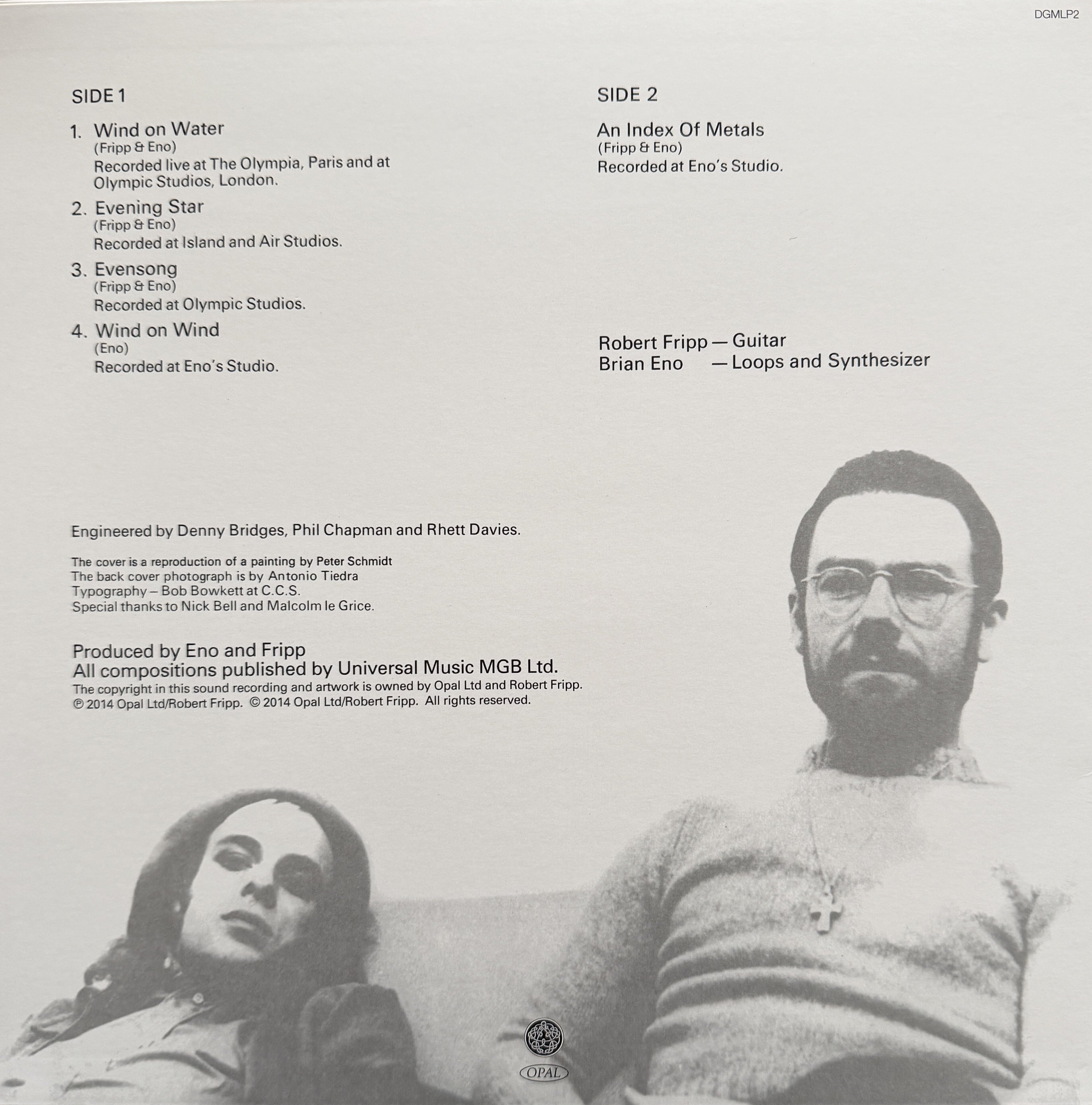
I have a beautiful version of this album: the Discipline Global Mobile (DGM) – DGMLP2. It is a 200 gram vinyl reissue, super-heavyweight, designed to ensure maximum stability during listening and reduce vibrations. It was recorded from the original master tapes, personally approved by Robert Fripp and Brian Eno. It also contains the original stereo mix from 1975, restored to offer superior sound quality compared to the old budget pressings. This reissue was released in 2014 and is part of a series of reissues edited directly by Robert Fripp's label. The goal is to bring the duo's classics back to the vinyl market after almost 30 years of absence.
"Wind on Water" is a calm sea, without waves, with a clear sky. A "maritime" ambient atmosphere, fluid and without any pressing rhythm. Brian Eno creates a carpet of synthesizers that envelops, filters and softens the sound. Robert Fripp, with his volume pedal, brings out long, dreamy notes, reminiscent of the sound of a cello or flute. Thanks to the sonic cleanliness of DGM vinyl, you can feel every little imperfection on the tape, almost as if you could hear the breath of the music.
"Evening Star" is the beating heart of the album, a perfect example of melodic minimalism. Fripp gives us one of his most famous solos, based on a cyclical scale that repeats itself endlessly. Eno, with his Frippertronics loops, creates a harmonic stratification that supports the lead guitar without ever overpowering it, creating an "ecstatic" atmosphere, as if time stopped.
"Evensong" is an interlude between the longer tracks. A dialogue between Eno and Fripp, where Eno introduces grainier textures and Fripp plays with shorter, plucked notes. It is the song that comes closest to certain more meditative King Crimson atmospheres, a moment of reflection and introspection.
In "Wind on Wind" Eno takes the lead, creating a pure ambient track, taken from his Discreet Music project. A constantly evolving soundscape, where musical phrases intersect almost randomly. Fripp is present with minimal, almost imperceptible interventions, which add spatial depth to the piece, like a touch of color on a white canvas.
"An Index of Metals" is an intense and experimental sonic journey, dark ambient, proto-industrial, a radical exploration of metallic sounds. Fripp, instead of playing melodies, produces controlled feedback and sharp distortions, turning his guitar into a source of "organized noise." Eno, with his real-time manipulation of tapes, saturates the signal, creating a sense of sound claustrophobia, an immersive and at times disturbing experience.
The artwork features a painting by artist Peter Schmidt (Eno's long-time collaborator) depicting the island of La Palma as seen from Tenerife.
Brian Eno's influence is palpable on this album, which stands out for its subtraction of elements. No percussion, drums or verse-chorus structures: the emphasis is placed on the layering, the stratification, of the music. Small melodic phrases slowly overlap through the use of loops, creating a complex sound texture rather than a linear melody. This accumulation process is enhanced by Robert Fripp's controlled improvisation, which plays over the loops in real time, interacting with what the tape gives him back. The experimental approach is total, pushing towards a primitive form of industrial or dark ambient music. The sounds are distorted, jarring and less reassuring, exploring the most extreme potential of tape manipulation.
"Evening Star" is a journey that starts from meditative peace and arrives at mechanical abstraction, making it a fundamental album for anyone who wants to understand the evolution of synthesizers and modern electronics.
My Version
Label: Discipline Global Mobile – DGMLP2
Format: Vinyl, LP, Album, Limited Edition, Remastered
Country: US
Release: 2014
Tracklist
1. Wind on Water (5:30)
2. Evening Star (7:48)
3. Evensong (2:53)
4. Wind on Wind (2:56)
5. An Index of Metals (28:36)
Duration 47:43
LineUp
- Robert Fripp - guitar, composer and producer
- Brian Eno - synthesizer, loop, composer and producer
Listening link on the main streaming platforms at the following links:
Spotify: Evening Star - Full Album
YouTube: Full Official Playlist
Apple Music: Evening Star - Robert Fripp & Brian Eno
YouTube Music: Album Stream

Note: All links to the musicians’ works are in the TAGS under the article title or on the "Artists"
.jpeg "Little Red Record by Matching Mole")