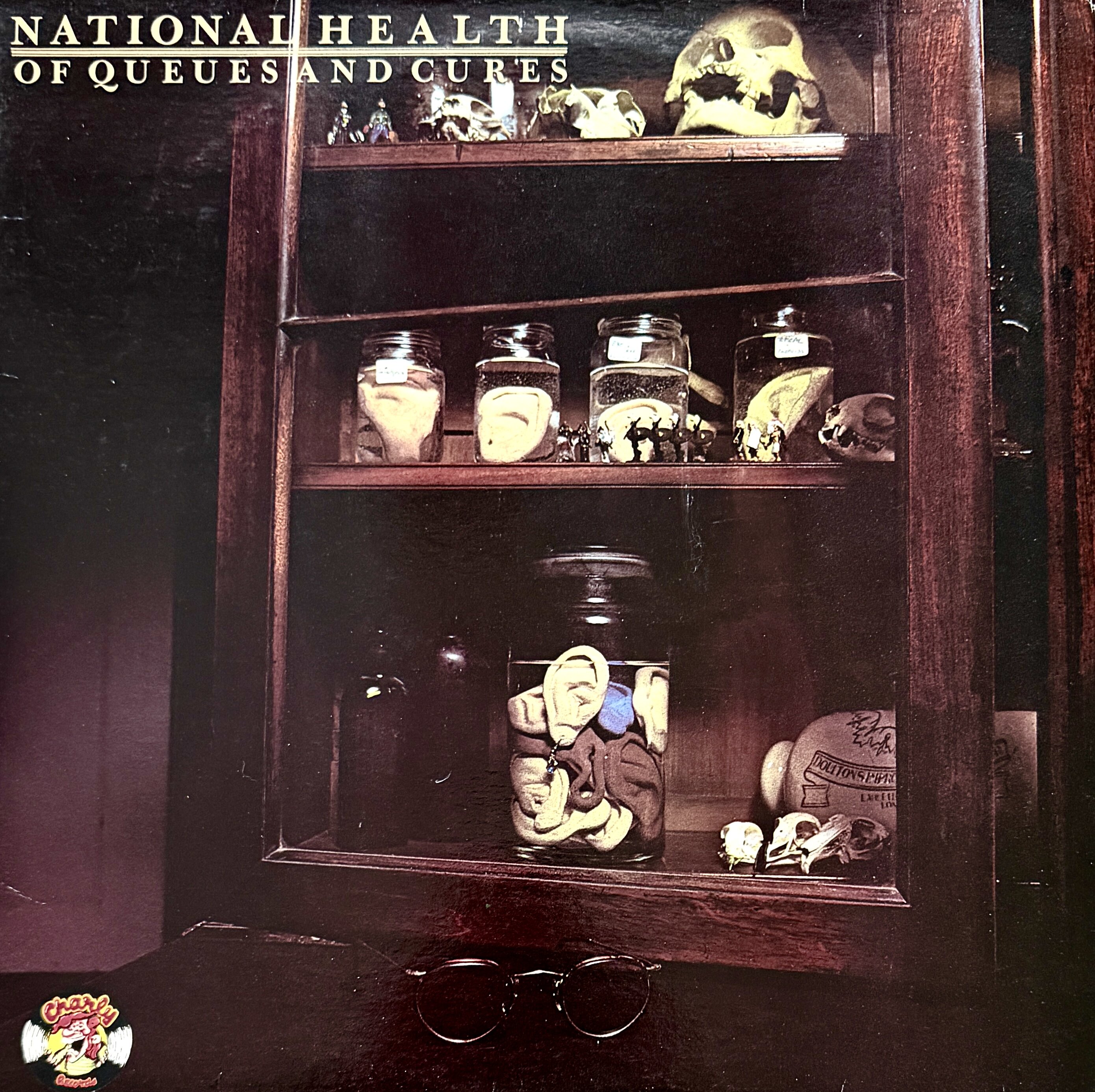

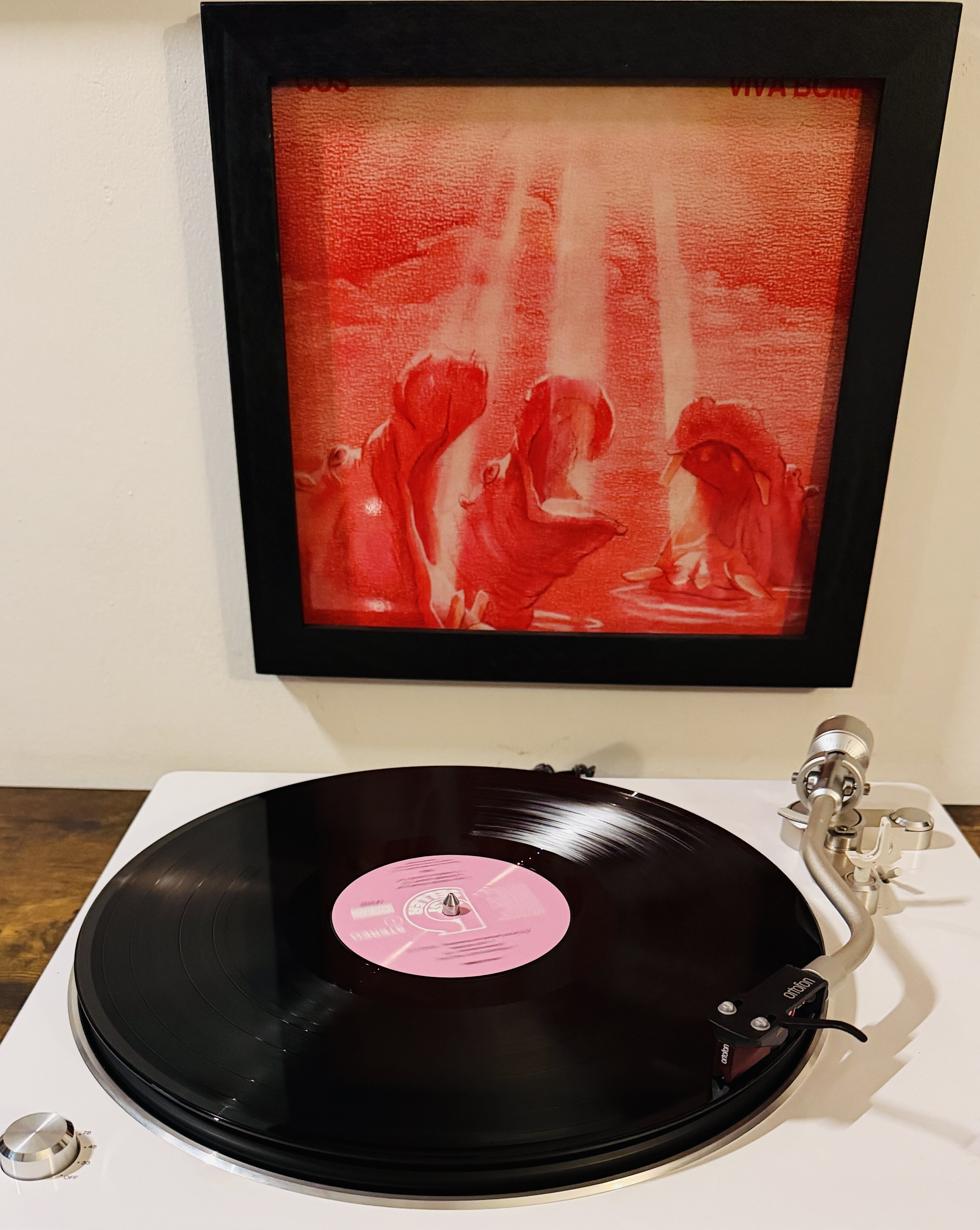
Viva Boma by COS, 1976 album.
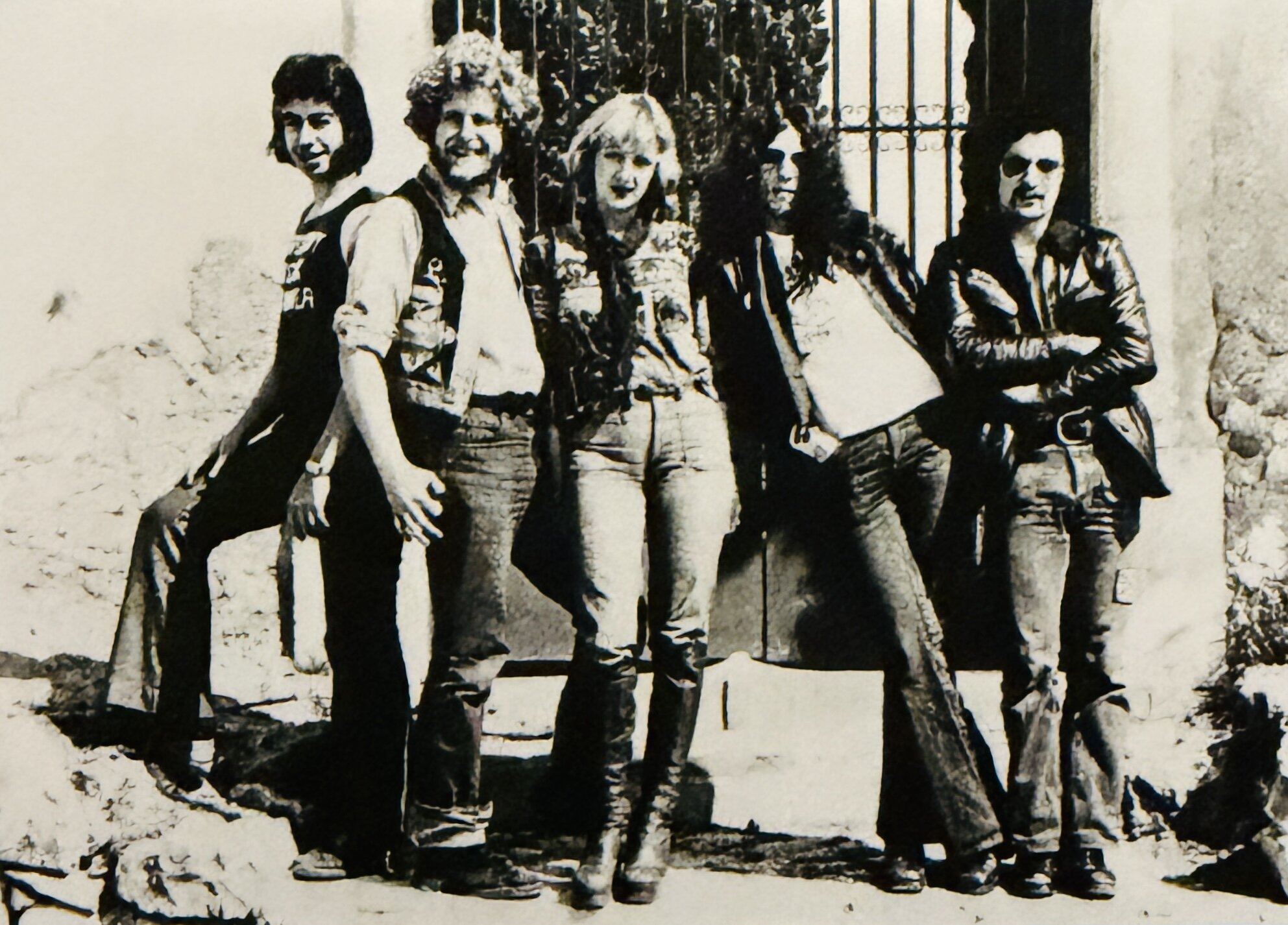
I discussed this band at length in my review of their debut album, Postaeolian Train Robbery, and in the dedicated article "The Hypnotic and Cryptic Language of COS." COS was one of the most innovative and original bands on the Belgian progressive rock and jazz-rock scene of the 1970s. Founded in 1973, with strong jazz-rock influences, they were part of a notable scene of Belgian rock bands active at the time.
A review has never been easier, thanks to the information provided by the record company, starting with the sticker and in the detailed insert inside the album.
Let's take a look at them. There's little more to add; the information provided is very comprehensive and detailed. I'll just add my impressions of the tracks and my final thoughts.
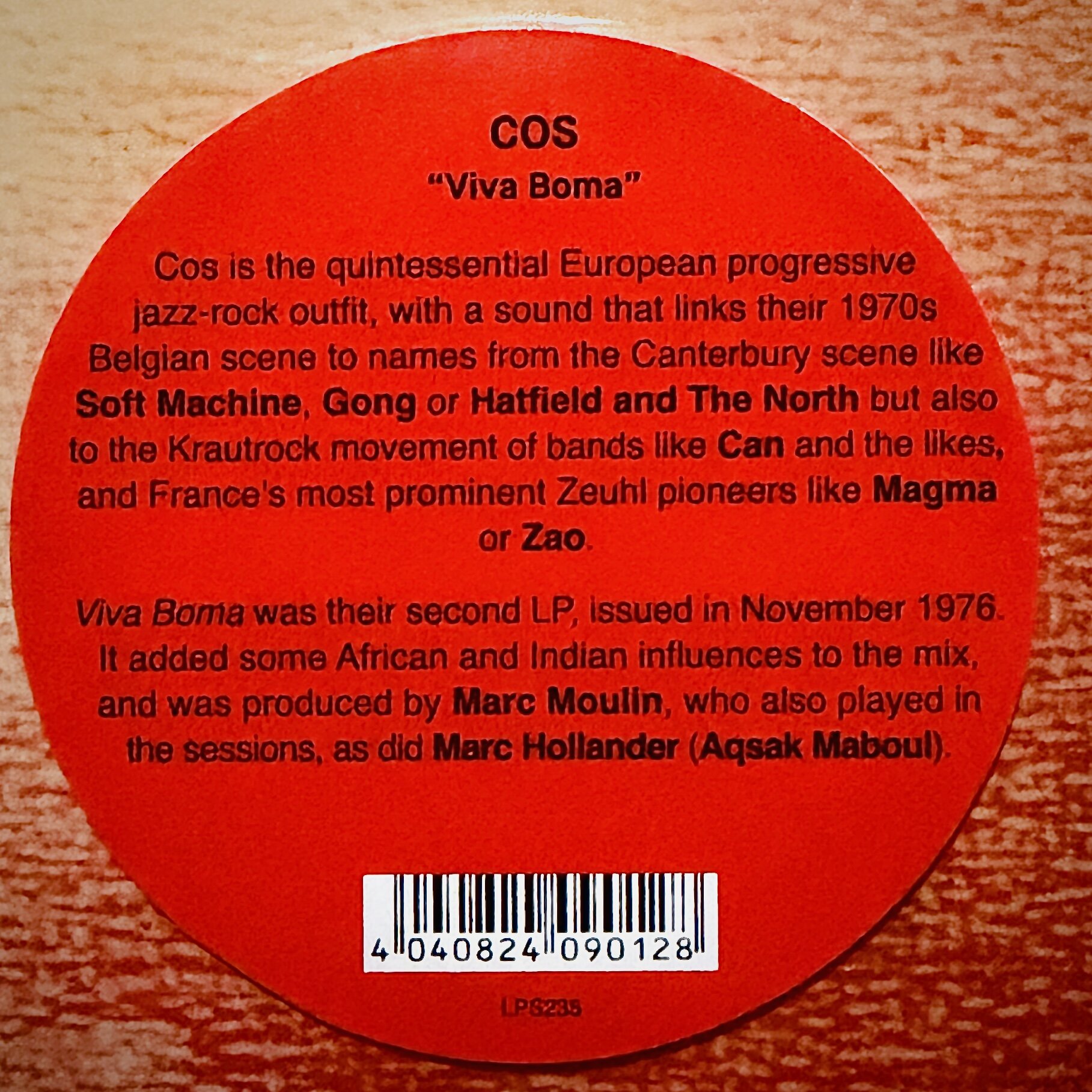
The sticker for this version states the following:
"COS "Viva Boma"
COS is the quintessential European progressive jazz-rock band, with a sound that connects their 1970s Belgian scene to names from the Canterbury scene like Soft Machine, Gong and Hatfield and the North, but also to the Krautrock movement of bands like Can and the like, and to the most important Zeuhl pioneers in France like Magma and Zao. Viva Boma was their second LP, released in November 1976. It added some African and Indian influences to the mix and was produced by Mare Moulin, who also played on the sessions, as well as Marc Hollander (Agsak Maboul)."
The inside insert features a beautiful description of the band and its sound, courtesy of Fluid Records, which curated this edition.
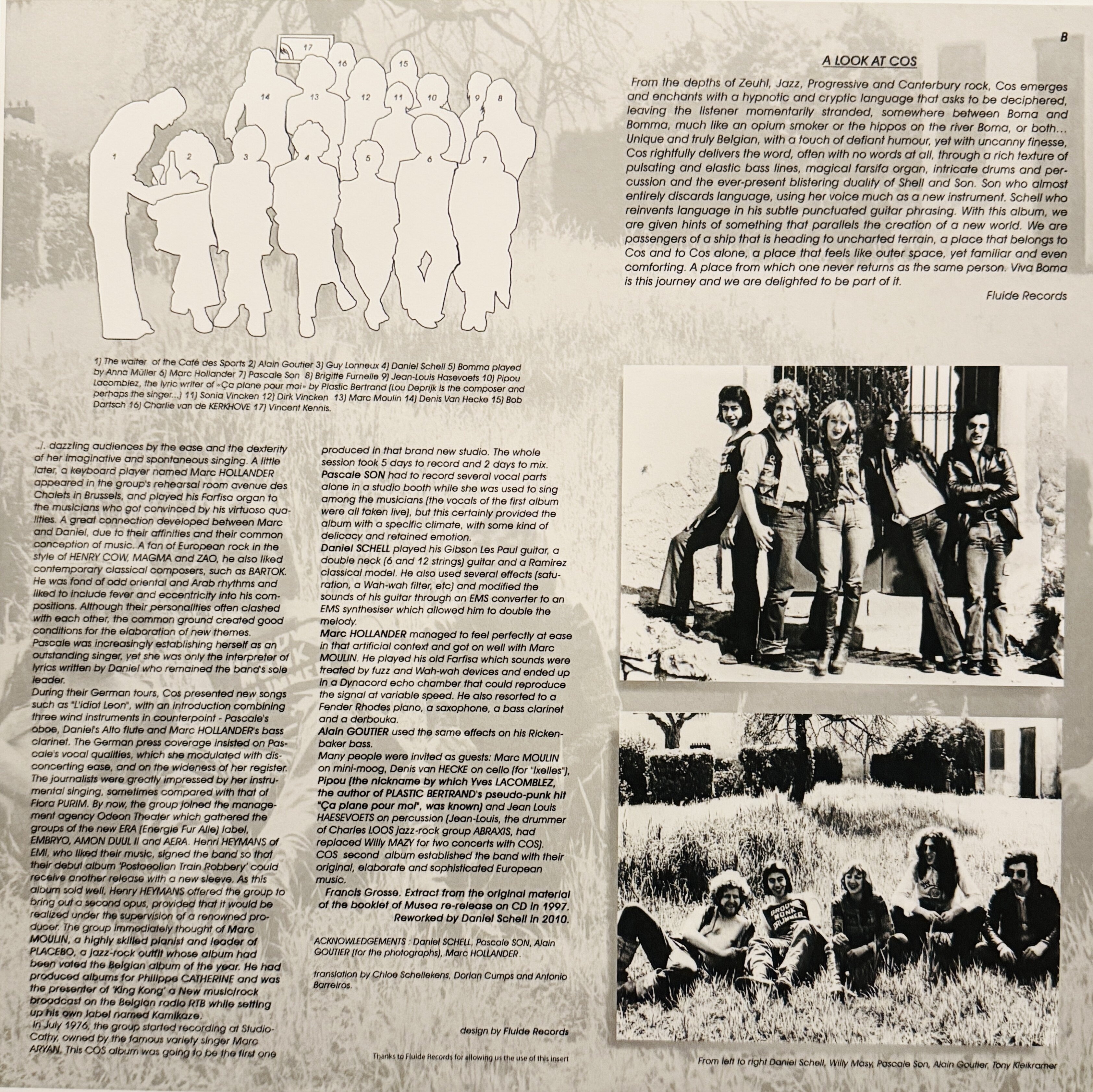
"A LOOK AT COS
From the depths of Zeuhl, jazz, progressive, and Canterbury rock, Cos emerges and enchants with a hypnotic and cryptic language that demands to be deciphered, leaving the listener momentarily stranded, somewhere between Boma and Bomma, just like an opium smoker or the hippos on the Boma River, or both...
Unique and truly Belgian, with a touch of defiant humor, but with incredible finesse, Cos rigorously pronounces the word, often without any words at all, through a rich texture of pulsating and elastic bass lines, magical farsifa organ, intricate drums and percussion, and the fiery duality of Shell and Son. Son almost completely discards language, using the voice as a new instrument. Schell reinvents language with his subtle, punctuated guitar phrases. With this album, We are given hints of something that parallels the creation of a new world. We are passengers on a ship heading into uncharted territory, a place that belongs to Cos and only Cos, a place that feels like space, yet is familiar and even comforting. A place from which one never returns as the same person. Viva Boma is this journey, and we are happy to be a part of it.
Fluid Records"
The inside insert also features Francis Grosse's album description. Grosse, while not a member of the band, is a key figure in their survival and diffusion. Together with Bernard Gueffier, he co-founded Musea Records, the French label specializing in progressive rock that played a fundamental role in Cos.
Thanks to Grosse and Musea, Cos masterpieces, such as "Postaeolian Train Robbery" and "Viva Boma," were released on CD between the late 1980s and 1990s. Without his dedication, many of these albums would have remained virtually unobtainable vinyl rarities.
Grosse has also released rare and unreleased material, such as the collection "The Approaching Storm," allowing the entire history of the Belgian band to be reconstructed. He is the primary historical curator of the Cos legacy, allowing a new generation of fans to discover their unique sound.
Here are his words:
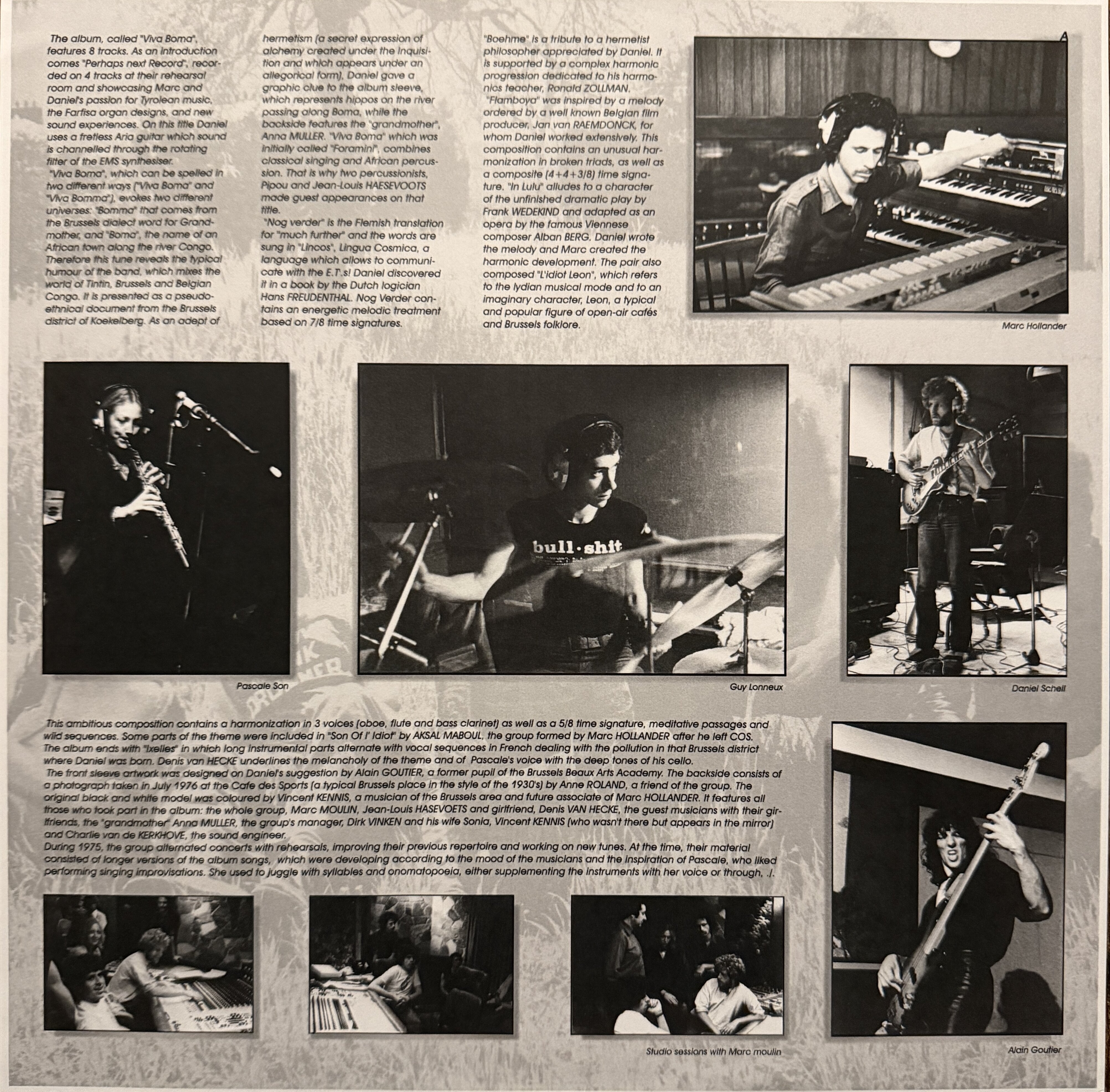
"The album, titled "Viva Boma," comprises eight tracks.
The introduction is "Maybe Next Record," recorded on four tracks in their rehearsal room and showcasing Marc and Daniel's passion for Tyrolean music, Farfisa organ designs, and new sonic experiences. For this recording, Daniel uses a fretless Aria guitar, whose sound is channeled through the rotary filter of the EMS synthesizer.
"Viva Boma," which can be written two different ways ("Viva Boma" and "Viva Bomma"), evokes two different universes: "Bomma," which comes from the Brussels dialect for grandmother, and "Boma," the name of an African city along the Congo River.
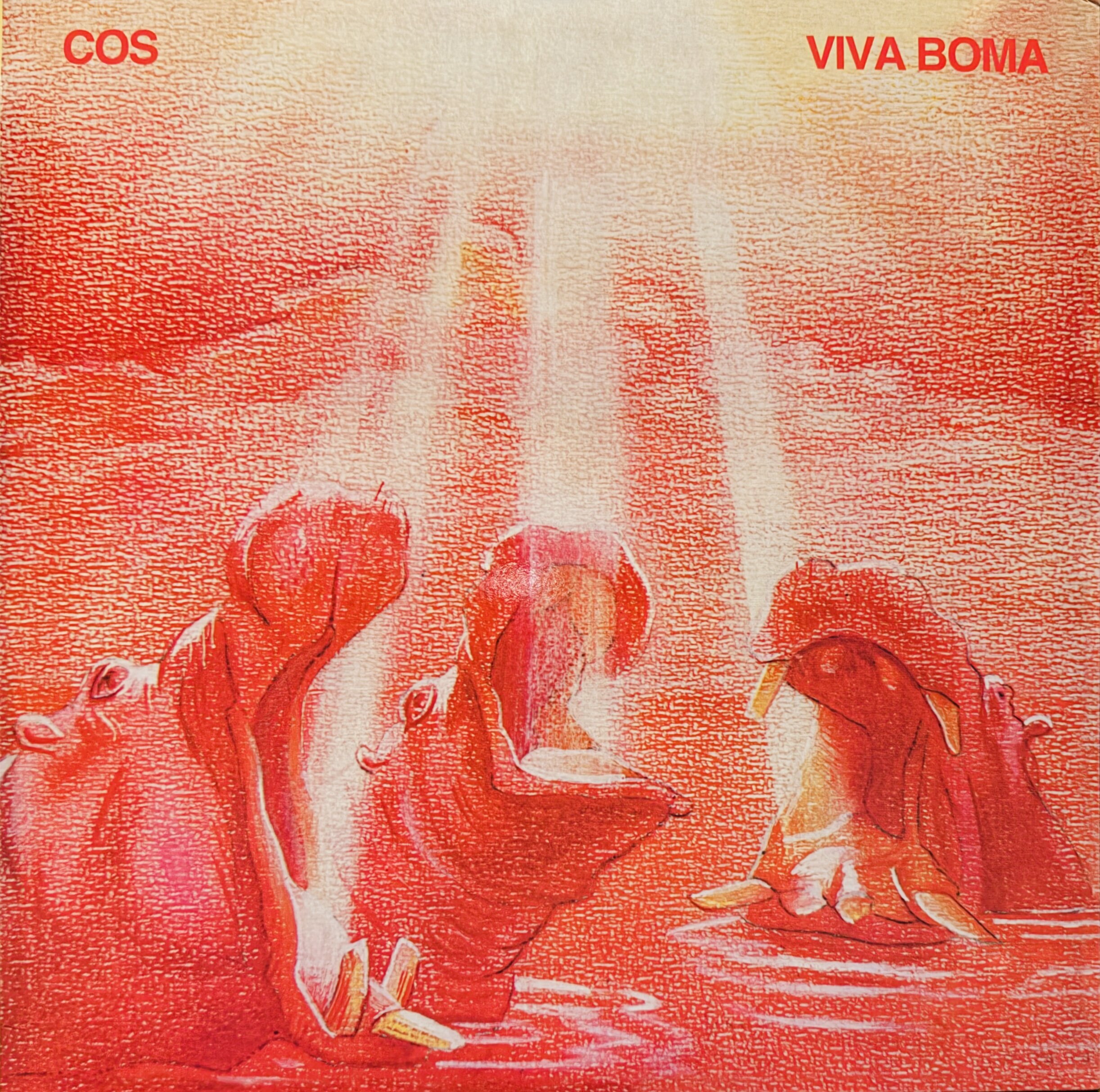
This melody thus reveals the band's characteristic humor, blending the worlds of Tintin, Brussels, and the Belgian Congo. It is presented as a pseudo-ethnic document from the Koekelberg district of Brussels. As an expert in hermeticism (a secret expression of alchemy created (during the Inquisition and appearing in allegorical form), Daniel gave a graphic clue to the album cover, which depicts hippos on the river passing by Boma, while the back features the "grandmother," Anna MULLER. "Viva Boma," initially called "Foramini," combines classical chant and African perception. That's why two percussionists, Pipou and Jean-Louis HAESEVOOTS, made special appearances on that title.
"Nog verder" is the Flemish translation of "farther away," and the lyrics are sung in "Lincos," Cosmic Tongue, a language that allows communication with E.T.s! Daniel discovered it in a book by Dutch logician Hans FREUDENTHAL. Nog Verder features an energetic melodic treatment based on 7/8 time signatures.
"Boehme" is a tribute to a Hermetic philosopher Daniel admired. It is supported by a complex harmonic progression dedicated to his harmonica teacher, Ronald Zollman.
"Flamboya" was inspired by a melody commissioned by renowned Belgian film producer Jan van Raemdonck, for whom Daniel worked extensively. This composition features an unusual harmonization in broken triads, as well as a composite signature (4+4+3/8).
"In Lulu" alludes to a character in Frank Wedekind's unfinished play, adapted into an opera by the renowned Viennese composer Alban Berg. Daniel wrote the melody, and Marc created the harmonic development.
The pair also composed "L'idiot Leon," which refers to the Lydian musical mode and a fictional character, Leon, a typical and popular figure in Brussels' street cafés and folklore. This ambitious composition features a three-part harmonization (oboe, flute, and bass clarinet) as well as a 5/8 time signature, thoughtful passages, and wild sequences. Portions of the theme were included in "Son Of l'Idlot" by AKSAL MABOUL, the group Marc HOLLANDER formed after leaving COS.
The album concludes with "Ixelles," in which long instrumental sections alternate with vocal sequences in French that address the pollution in the Brussels neighborhood where Daniel was born. Denis van HECKE emphasizes the melancholy of the theme and Pascale's voice with the deep tones of his cello.
The front cover illustration was designed at Daniel's suggestion by Alain GOUTIER, a former student of the Brussels Beaux Arts Academy.
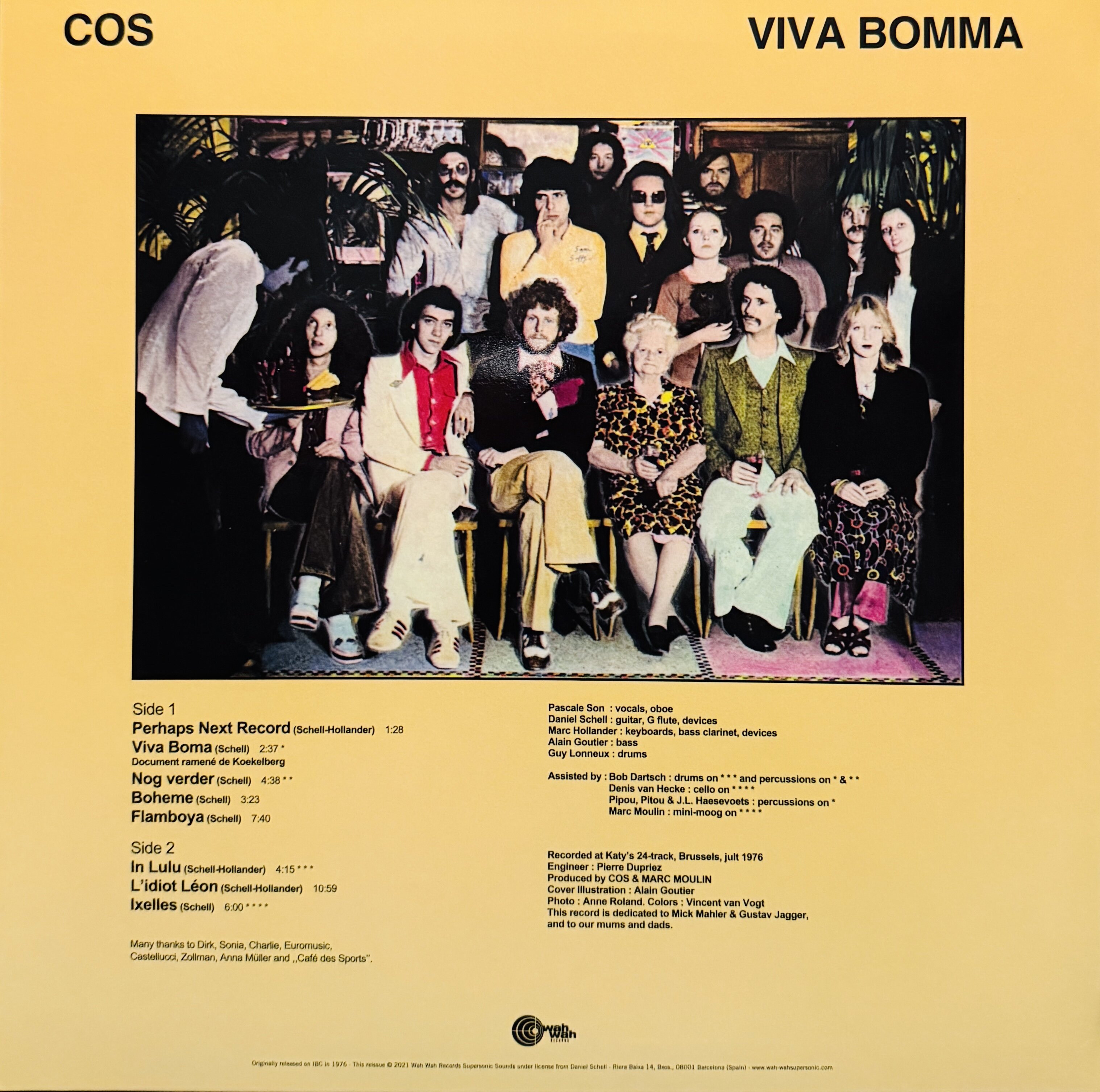
The back features a photograph taken in July 1976 at the Cafe des Sports (a typical 1930s-style Brussels bar) of Anne ROLAND, a friend of the group. The original black-and-white model was colored by Vincent KENNIS, a musician from the Brussels area and future collaborator of Maro Hollander. Everyone who participated in the album is included: the entire group, Marc MOULIN, Jean-Louis HASEVOETS and his boyfriend, Denis VAN HECKE, the guest musicians and their friends, "grandmother" Anna MULLER, the group's manager, Dirk VINKEN and his wife, Sonla, Vincent KENNIS (who was not present but appears in the mirror), and Charlie van de KERKHOVE, the sound engineer.
In 1975, the group alternated concerts and rehearsals, improving their previous repertoire and working on new songs. At the time, their material consisted of longer versions of the album's songs, which evolved according to the musicians' moods and the inspiration of Pascale, who loved to perform improvisational vocals. She was known to juggle syllables and onomatopoeia, integrating the instruments with her voice or dazzling the audience with the ease and dexterity of her imaginative and spontaneous singing.
Shortly afterward, a keyboardist named Marc Hollander appeared at the group's rehearsal space on Avenue des Chalets in Brussels and played his Farfisa organ for the musicians, who were won over by his virtuosity. A strong bond developed between Marc and Daniel, thanks to their affinity and shared understanding of music. A fan of European rock in the style of HENRY COW, MAGMA, and ZAO, he also loved contemporary classical composers, such as BARTOK.
He loved oriental and Arabic rhythms and loved incorporating feverishness and eccentricity into his compositions. Although their personalities often clashed, their shared ground created favorable conditions for developing new themes.
Pascale was increasingly establishing herself as an exceptional singer, but she was merely the interpreter of the lyrics written by Daniel, who remained the band's sole leader.
During their German tours, Cos presented new songs like "L'idiot Leon," with an introduction that combined three wind instruments in counterpoint: Pascale's oboe, Daniels' alto flute, and Marc Hollander's bass clarinet. German press coverage emphasized Pascale's vocal qualities, which she modulated with disconcerting ease, and the breadth of her range.
Journalists were greatly impressed by her instrumental singing, sometimes compared to that of Flora PURIM.
Meanwhile, the group had attracted the attention of the Odeon Theater management agency, which included bands from the new label ERA (Energie Für Alle), EMBRIONE, AMON DUUL II, and AERA. Henri Heymans of EMI, who loved their music, signed the band so that their debut album, "Postgeolian Train Robbery," could be reissued with a new cover. Since this album sold well, Henry Heymans offered the group the opportunity to release a second album, provided it was produced under the supervision of a renowned producer. The group immediately thought of Marc Moulin, a highly skilled pianist and leader of Placebo, a jazz-rock band whose album had been voted Belgian album of the year. He had produced albums for Philippe Catherine and hosted "King Kong," a new music/rock show on Belgian radio RTB, while also founding his own label, Kamikaze.
In July 1976, the group began recording at Studio-Cathy, owned by the famous pop singer Marc ARYAN. This COS album would be the first to be produced at that new studio. The entire session took five days to record and two days to mix.
Pascale SON had to record several vocals alone in a studio booth, as she was used to singing among the musicians (the vocals on the first album were all recorded live), but this certainly gave the album a specific atmosphere, a certain delicacy, and preserved emotion.
Daniel SCHELL played his Gibson Les Paul guitar, a double-neck guitar (6 and 12 strings), and a classic Ramirez model. He also used various effects (saturation, wah-wah filter, etc.) and modified his guitar sounds using an EMS converter in an EMS synthesizer, allowing him to double the melody.
Marc Hollander felt perfectly at home in this artificial environment and got along well with Marc Moulin. He played his old Farfisa, whose sounds were processed with fuzz and wah-wah effects and fed into a Dynacord echo chamber capable of reproducing the signal at variable speed. He also used a Fender Rhodes piano, a saxophone, a bass clarinet, and a derbouka.
Alain Goutier used the same effects on his Ricken-baker bass.
Many guests were invited: Marc MOULIN on mini-Moog, Denis van HECKE on cello (for "Ixelles"), Pipou (the nickname by which Yves LACOMBLEZ, author of PLASTIC BERTRAND's pseudo-punk hit "Ça plane pour moi," was known), and Jean-Louis HAESEVOETS on percussion (Jean-Louis, drummer for Charles LOOS's jazz-rock band ABRAXIS, had replaced Willy MAZY for two concerts with COS).
COS's second album cemented the band's reputation with their original, elaborate, and sophisticated European music.
Francis Grosse. Excerpt from the original booklet for the 1997 Musea CD reissue. Reworked by Daniel Schell in 2010.
ACKNOWLEDGMENTS: Daniel SCHELL, Pascale SON, Alain GOUTIER (for the photographs), Mare HOLLANDER.
Translation by Chloe Schellekens, Dorian Cumps, and Antonio Barreros.
Design by Fluide Records
Thanks to Fluide Records for permission to use this insert."
My impressions of the tracks:
“Perhaps Next Record” by Marc Hollander is a brief electronic prelude, a minute-long divertissement with Mini-Moog and futuristic effects. Disconcerting and ironic, it serves to reset the listener's ears, announcing an avant-garde experience, far removed from typical '70s rock.
“Viva Boma,” the title track, introduces African percussive rhythms and a pulsating bass, heralding the group's ethnic experimentation. It sets the mood of the album with the ethno-jazz influence of a hypnotic bass that supports Pascale Son's wordless vocal melody. The percussion parts are masterful.
"Nog Verder" begins as a slow, dreamy jazz-fusion piece, driven by a Fender Rhodes electric piano. It then accelerates into a tight, Weather Report-like funk that highlights the technical precision of Cos. The tempo changes are fluid, and the dialogue between Daniel Schell's guitar and the horns is excellent. One of the most fusion-oriented tracks.
"Boehme," dedicated to the philosopher Jakob Böhme, is a complex track with sophisticated harmonies. The distorted organ and dark atmosphere create an intense sonic experience. The song pays homage to Böhme's mysticism and recalls Magma's Zeuhl style. Pascale Son's vocals become sharp and dramatic, while the distorted organ weaves a dense sonic carpet.
"Flamboya," one of the album's highlights, stands out for its odd 5/4 time signature and Pascale Son's vocals, reminiscent of those of Gilly Smyth of Gong. The bass part is splendid, with its minimalist soundscapes, often considered the album's masterpiece. The song, despite its rhythmic complexity, maintains an irresistible groove. A more refined and jazzy version of Daevid Allen's Gong.
"Lulu" is a dreamy, oriental piece, with fluid guitars and intricate percussion creating a hypnotic effect. More atmospheric and delicate than the previous songs, the acoustic guitar and woodwinds dominate, giving it an oriental, bucolic feel. This track offers a moment of respite from the complexity of the previous pieces, demonstrating the group's versatility in handling volume and dynamics.
"L'Idiot Léon," the album's longest track (over 10 minutes), is a suite that alternates calm and instrumental explosions with oboe, flute, and bass clarinet. It is one of the best examples of the Canterbury style and the album's masterpieces. A suite that alternates frenetic jazz-rock sections with moments of sonic abstraction. The bass clarinet adds depth, reminiscent of Third-era Soft Machine. A monument to the Canterbury scene.
"Ixelles," the album's final track, combines synths and cello in refined instrumental combinations. Pascale Son's vocals add a touch of absolute elegance. Unlike the other tracks, "Ixelles" stands out for its perfectly intelligible French lyrics. This avant-garde piece is dominated by a melancholic cello intertwined with synths, closing the album on a tone of sophisticated European decadence.
"Viva Boma" is a hypnotic album that blends African jungle and Brussels jazz. Cos abandon prog imitations and create a unique language, making it a cult classic.
Pascale Son's voice takes center stage, used as an instrument with phonemes, sighs, and warbles, Gong-style but with a precision that enhances its expressiveness. The tribal groove, with bass and guitar intertwining in circular patterns, creates a hypnotic trance.
Marc Moulin's production is clean and spatial, enhanced by Marc Hollander's Dadaist synthesizers. A crescendo of ethno-jazz-rock blends with the band's darker, more experimental side.
Perfect for those who love the Canterbury Sound but are looking for something more exotic and rhythmic, this album demands careful listening.
Tracklist
My Version:
Label: Wah Wah Records – LPS235
Format: Vinyl, LP, Album, Limited Edition, Reissue, Remastered, Stereo
Country: Spain
Release Date: 2021
From the Back Cover
COS VIVA BOMMA
Side 1
Perhaps Next Record (Schell-Hollander) 1:28
Viva Boma (Schell) 2:37 *
Document ramené de Koekelberg
Nog verder (Schell) 4:38**
Boheme (Schell) 3:23
Flamboya (Schell) 7:40
Side 2
In Lulu (Schell-Hollander) 4:15***
L'idiot Léon (Schell-Hollander) 10:59
Ixelles (Schell) 6:00 ****
LineUp
Pascale Son: vocals, oboe
Daniel Schell: guitar, G flute, gear
Marc Hollander: keyboards, bass clarinet, gear
Alain Goutier: bass
Guy Lonneux: drums
With:
Bob Dartsch: drums on *** and percussion on * & **•
Denis van Hecke: cello on ****
Pipou, Pitou & J.L. Haesevoets: percussion on *
Marc Moulin: mini-moog on *
Recorded at Katy's 24-track, Brussels, July 1976
Engineer: Pierre Dupriez
Produced by COS & MARC MOULIN
Cover illustration: Alain Goutier
Photo: Anne Roland
Colors: Vincent van Vogt
Dedications and thanks
This album is dedicated to Mick Mahler & Gustav Jagger, and to our moms and dads.
A big thank you to Dirk, Sonia, Charlie, Euromusic, Castellucci, Zollman, Anna Müller, and "Café des Sports."
Originally released on IC in 1976 - This reissue is © 2021 Wah Wah Records Supersonic Sound and is licensed by Daniel Schell - Riera Baika 14, Bos., 08001 Barcelona (Spain): www.wah-wahsupersonic.com
Note: All links to the musicians' works are in the TAGS under the article title or on the "Artists" page.
.jpeg "Postaeolian Train Robbery by Cos")